Steven Pinker: Language is an instinct (1994)
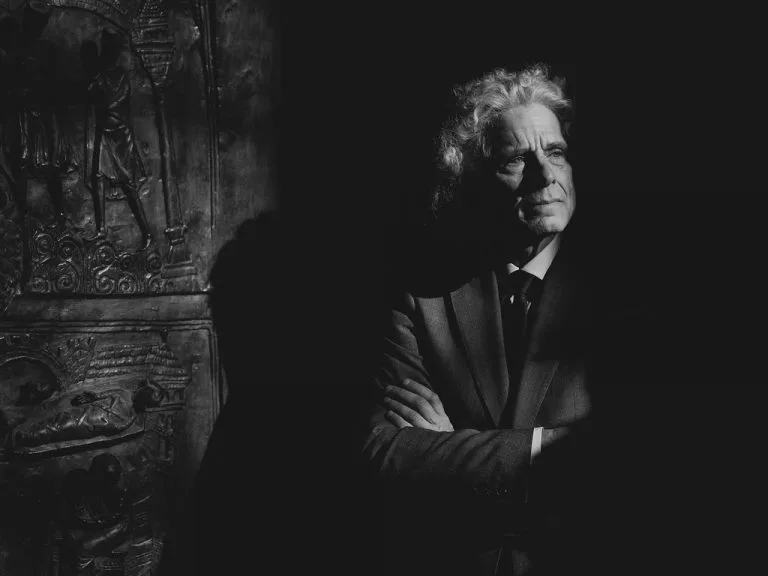
The language instinct is Steven Pinker’s name for the idea that the human capacity for language is a biological adaptation — a piece of instinctive know-how as much a part of our species as spinning a web is part of a spider’s, and shaped, like the web, by natural selection. Pinker (born 1954), a cognitive scientist who taught at MIT and Harvard, set out the case in his 1994 bestseller The Language Instinct. He borrowed the phrase from Charles Darwin, who had already written that humans have “an instinctive tendency to speak”. Pinker’s position sits inside the nativist tradition founded by Noam Chomsky — he takes over Chomsky’s claim that a rich, universal grammar is built into the child — but he pushes it somewhere Chomsky refused to go: language, he argues, is not a mysterious by-product of a big brain but a Darwinian adaptation, designed by selection for the job of communication.
The Language Instinct (1994)
The book’s central move is to reframe an old debate. Where Chomsky argued about grammar as an abstract, formal system, Pinker argued about it as biology — something you can reason about the way you reason about the eye or the hand. Three of his arguments do most of the work.
Language is instinctive, not taught. Pinker marshals the familiar nativist evidence — the poverty of the stimulus, the uniform grammar every child reaches without instruction, the critical period after which fluency becomes hard — and reads all of it as the signature of an instinct. A child no more “learns” the deep design of grammar than a spider learns to spin; the environment supplies the vocabulary and the particular language, but the machinery for structuring it comes as standard equipment.
Thought is not the same as language: mentalese. One of the book’s most influential arguments is that we do not think in English, or Dutch, or Chinese. Beneath any spoken language lies a silent internal code Pinker calls mentalese — a “language of thought” in which concepts are represented before they are dressed in words. Speaking is translation from mentalese into a public tongue; understanding is translation back. This is why you can grasp a meaning and yet grope for the words, why translation between languages is possible at all, and why the strong claim that language shapes thought (linguistic relativity) is, in Pinker’s view, largely overstated: the thinking is going on below the words.
Children build grammar the adults around them lack. Pinker’s most vivid evidence is creolisation. When adults thrown together without a common tongue improvise a rough, grammarless pidgin, the children who grow up hearing it do not merely copy it — they turn it into a full creole with consistent grammar the adults never supplied. Derek Bickerton documented this for spoken creoles; the emergence of Nicaraguan Sign Language — a whole grammar grammaticalised out of gesture by deaf children in the 1980s — became the textbook case. Children, Pinker argues, do not just absorb language; where it is missing, they generate it. That is what an instinct looks like.
The evolution of language: adaptation, not spandrel
Here Pinker parts company with Chomsky most sharply, and the disagreement is worth stating precisely because it is often missed: the two men agree that language is innate and biological — they disagree about how it got there.
Chomsky has always been sceptical that natural selection explains the language faculty, suggesting it may have arisen as a side effect of some other change — a bigger brain, an unknown law of physics or growth. The evolutionary biologist Stephen Jay Gould gave this kind of non-adaptive trait a name: a spandrel, after the roughly triangular spaces left over when you set a dome on four arches — a by-product of the architecture, not something the builder set out to make.
In a landmark 1990 paper, Natural Language and Natural Selection, Pinker and the psychologist Paul Bloom argued the opposite. Grammar, they said, shows exactly the kind of intricate, well-engineered complexity — many parts coordinated for a function — that in biology is the fingerprint of natural selection and of nothing else. Pinker’s retort to the spandrel image is memorable: a dome on four arches does indeed give you spandrels for free, but it does not give you a mosaic depicting an evangelist pouring water from a pitcher. To get the mosaic you need a designer, and in biology the only designer on offer is selection. The 1990 paper is widely credited with making the evolution of language a respectable scientific question again after decades in which it had been almost taboo.
Words and Rules (1999)
Pinker’s other major contribution zooms in from the sweep of evolution to a single, almost trivial-looking corner of grammar: the past tense. In Words and Rules (1999) he uses the contrast between regular verbs (walk → walked) and irregular ones (go → went) as a window onto the whole architecture of language, and the answer he gives is that language runs on two different systems, not one.
- Rules handle the regular cases. There is no need to store walked, jumped and emailed separately; a single combinatorial rule — “add -ed” — generates them on the fly and applies automatically to any new verb (you instantly know the past tense of to google). This is the productive, open-ended engine of grammar.
- Words handle the irregular cases. Went, sang, brought cannot be derived by rule; they must be memorised one by one and simply looked up, like any other item in the mental dictionary.
The interest of this is that the two systems map onto two different kinds of memory — and here Pinker’s linguistics meets neuroscience. The irregular forms live in declarative memory, the store of facts and arbitrary associations; the regular rule is a matter of procedural memory, the system for combinatorial skills. This is precisely the declarative/procedural model that the neuroscientist Michael Ullman built and tested: irregulars stored as declarative facts in temporal-lobe memory, regulars computed by a procedural system rooted in the basal ganglia and frontal cortex. Words-and-rules thus supplied the linguistic half of a dual-system picture of language that brain imaging and patient studies would go on to support — and it stood against the rival connectionist claim (Rumelhart and McClelland, 1986) that a single associative network, with no rules at all, could do the whole job.
Criticism and the state of the debate
The instinct metaphor is bold, and it drew fire from every anti-nativist quarter. The most sustained attack is Geoffrey Sampson’s The “Language Instinct” Debate (2005, an enlarged edition of his 1997 Educating Eve), a book-length empiricist rebuttal. Sampson argues that the poverty-of-the-stimulus premise is simply false — corpus data show that the speech children hear is far richer than the nativist story assumes — and that language is learned, like other cultural skills, by ordinary hypothesis-testing against a generous environment. If the input is rich enough, no innate grammar is needed to explain the outcome.
The usage-based school (Michael Tomasello and others) presses the same point constructively: children build grammar bottom-up from the concrete phrases they hear, using general-purpose abilities to read intentions and detect patterns, with no language-specific instinct required. And the field data cut at the “universal” in Pinker’s universal instinct: Daniel Everett’s claim that Pirahã lacks recursion is offered as evidence that grammar is a cultural tool shaped by a people’s way of life, not a fixed biological given.
Where does Pinker stand now? He remains one of the most widely read scientists alive and has not retreated from the adaptationist position; the 1990 evolution argument, in particular, has aged well and is broadly accepted. But the strong version of a single, dedicated “language instinct” is contested as sharply as Chomsky’s Universal Grammar, and for the same reasons — powerful general-purpose statistical learning, cross-linguistic diversity, and large language models that acquire fluent syntax with no built-in grammar at all (though on far more text than any child hears). What survives most robustly is the narrower, better-evidenced claim: something in human biology makes language effortless for our species, and grammar is at least partly computed by rules, not merely remembered.
What this means for learning a language
Pinker’s work is about how children come by their first language, but two of its ideas carry straight over to an adult learning a second one.
The first is words and rules together. A language is not one thing to master but two: a large body of items that can only be memorised — vocabulary, idioms, irregular forms, the fixed phrases native speakers actually say — and a smaller set of productive rules that let you generate sentences you have never heard. Good learning feeds both. Drilling rules alone leaves you fluent in a grammar you cannot fill with words; hoarding vocabulary alone leaves you with a phrasebook and no way to combine it. The declarative half is built the way declarative memory is always built — by spaced, repeated retrieval — while the procedural, rule-following half is built by use, by producing and meeting whole sentences until the patterns run automatically. That division of labour is exactly the declarative-versus-procedural distinction from memory research.
The second is sentences over tables. On Pinker’s account children never internalise grammar from paradigms; they extract it from a flood of meaningful utterances. An adult brain is less pliable, so it needs explicit rules as scaffolding in a way a three-year-old’s does not — but the raw material of fluency is the same: whole sentences met and produced repeatedly in context, with rules as a support rather than the starting point. That is the principle behind sentence-based learning with active recall — memorise the words that must be memorised, internalise the rules that can be generated, and let both grow out of real sentences rather than lists.
FAQ
What is the language instinct in one sentence?
It is Steven Pinker’s idea, set out in his 1994 book, that the human capacity for language is a biological adaptation — an instinct built by natural selection, like a spider’s web-spinning — rather than a cultural invention that each generation learns from scratch.
How does Pinker differ from Chomsky?
They agree that grammar is innate and universal, so Pinker is squarely a nativist. They disagree about origins: Chomsky doubts that natural selection explains the language faculty and leans towards it being a by-product of other changes, whereas Pinker (with Paul Bloom, 1990) argues that the intricate design of grammar is precisely what natural selection, and only natural selection, produces. Pinker also writes for a general audience and folds in evolutionary biology and psychology where Chomsky stays formal and abstract.
What is the “words and rules” theory?
It is Pinker’s claim that language runs on two systems: irregular forms (went, sang) are memorised as whole words in declarative memory, while regular forms (walked, emailed) are generated on demand by a rule (“add -ed”) handled by procedural memory. It maps onto Michael Ullman’s declarative/procedural model of language in the brain, and it argues against single-system connectionist accounts that use no rules at all.
Sources
- Steven Pinker, The Language Instinct: How the Mind Creates Language, William Morrow, 1994.
- Steven Pinker and Paul Bloom, “Natural Language and Natural Selection”, Behavioral and Brain Sciences 13 (1990): 707–784.
- Steven Pinker, Words and Rules: The Ingredients of Language, Basic Books, 1999.
- Michael T. Ullman, “A neurocognitive perspective on language: the declarative/procedural model”, Nature Reviews Neuroscience 2 (2001): 717–726.
- Geoffrey Sampson, The “Language Instinct” Debate, revised edition, Continuum, 2005.