Distance Learning in Language Education
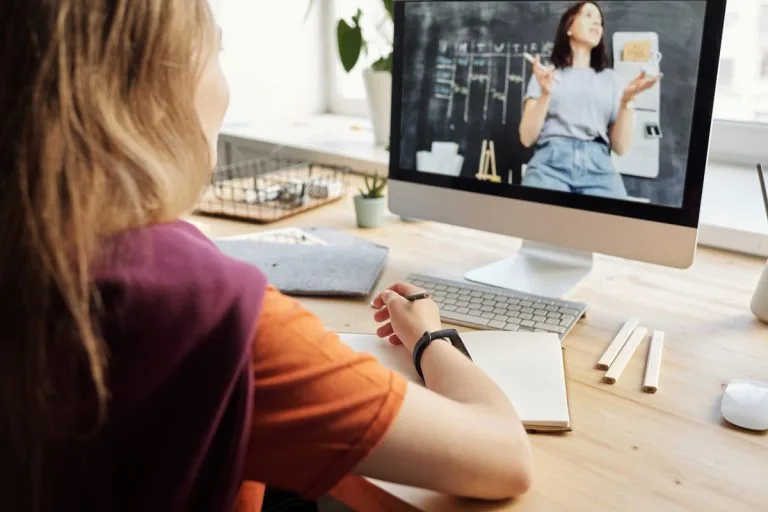
Distance learning in language education means studying a language while separated from your teacher in space, and usually in time, with the gap bridged by some medium — the post, a broadcast signal, or a network connection. The definition sounds modern, but the practice is older than the telephone: people were learning languages by mail more than a century before anyone learned one from a screen. What unites a Victorian correspondence course and a phone app used on a commute is a single problem — how do you teach a language to someone who is not in the room? — and a single demand it makes of the learner, which is that they carry much of the work themselves. The technology has changed completely; that demand has not.
A short history: from the mail to the MOOC
Distance education has a surprisingly precise origin. In 1728 a Boston shorthand teacher named Caleb Phillipps advertised lessons sent “weekly to any Person in the Country” — a course delivered entirely by post. A century later Isaac Pitman was teaching his shorthand system by mail across Britain, and in 1858 the University of London opened its External Programme, the first scheme to let students anywhere in the world sit for a real degree without attending a single lecture. Languages were among the earliest subjects taught this way, because a printed grammar, a reader and a set of graded exercises could carry a great deal of a language through the mail even if they could not carry its sound.
The next leap was broadcast. Radio reached education quickly: by 1923 more than a tenth of American radio stations were owned by colleges and universities, and language lessons went out over the air to anyone with a receiver. Television added pictures in the 1930s — the University of Iowa was broadcasting courses by 1934 — and the model reached its grandest scale in 1969 with Britain’s Open University, which used BBC television and radio alongside posted printed materials to teach at university level with no entry requirements at all. This is the phase historians Michael Moore and Greg Kearsley describe as the second and third of distance education’s “generations”: mass media and the open university, following the first generation of correspondence by post.
Then came the computer. The first course taught entirely online ran at the University of Toronto in 1984, and within a decade the World Wide Web had dissolved the old limits of distribution: content no longer had to fit on a mailed page or a broadcast schedule, and learners could reach authentic texts, recordings and each other directly. This is where distance learning merges with computer-assisted language learning (CALL) — the two fields have been braided together ever since. The most visible recent chapter is the MOOC: 2012 was dubbed “the year of the MOOC” as edX, Coursera and Udacity launched free courses to hundreds of thousands of students at once, with language courses consistently among the most popular. Today the dominant form is smaller and closer to hand — the language app in your pocket is, in the end, a direct descendant of Caleb Phillipps’ posted lessons.
The models: synchronous, asynchronous, and exchange
Distance language learning comes in two basic timings. Asynchronous learning is self-paced: recorded lessons, readings, exercises and discussion boards that the learner works through whenever they choose. Its great strength is flexibility, and its great demand is autonomy — nobody is waiting for you, so nobody makes you show up. Synchronous learning happens live: a video class, a one-to-one tutoring session, a scheduled conversation group. It restores the immediate back-and-forth of a classroom and, crucially for languages, gives real-time speaking practice — but it trades away the flexibility that draws many learners to distance study in the first place. Most serious programmes now blend the two, using asynchronous material for input and synchronous sessions for interaction.
A distinctive third model tackles the hardest thing to do at a distance: genuine spoken interaction with a native speaker. Telecollaboration — also called virtual exchange — pairs learners in different countries to communicate through online tools, learning language and culture from each other rather than from a single teacher. Its most language-focused variant is tandem exchange: two people who each speak the language the other wants to learn take turns, so each is by turns learner and native-speaker model. The teletandem approach, developed in Brazil in the mid-2000s, put this online and made it oral, using video calls so the partners actually speak to one another. These models answer the classic weakness of distance language study — that it is easy to deliver grammar and vocabulary by post or screen, and hard to deliver conversation — by turning the network itself into the source of a live partner.
What the research says: the design beats the medium
For decades, studies comparing distance and classroom education kept returning the same anticlimactic verdict, so consistent it earned a name: the “no significant difference” phenomenon. A large 2004 meta-analysis by Robert Bernard and colleagues confirmed it — across achievement, attitude and retention, distance and face-to-face instruction came out roughly even. A widely cited 2013 meta-analysis for the U.S. Department of Education (Means and colleagues) refined the picture: on average online instruction was at least as effective as face-to-face, often modestly better, and blended courses — part online, part in person — did best of all. Tellingly, foreign-language courses showed one of the largest advantages for the distance format, which the researchers attributed to the regular online interaction with native speakers that the medium makes easy to arrange.
The recurring lesson is that the delivery channel is not the active ingredient. What predicts a good outcome is sound design — meaningful practice, timely feedback, and interaction — not whether the class is in a room or on a screen. The most useful theory here is Michael Moore’s transactional distance: the real “distance” in distance education is pedagogical and psychological, not geographic. It grows or shrinks according to three things — the amount of dialogue between teacher and learner, the rigidity of the course structure, and the autonomy of the learner. Two students in the same online course can be at very different transactional distances. You close the gap with more dialogue and better-fitted structure; and the more autonomous the learner, the more distance they can absorb without the learning suffering. It is the theoretical version of the empirical finding: a well-designed course at a distance beats a badly designed one in person.
Distance learning today: autonomy, apps and tandem
In early 2020 the whole world took a crash course in distance education. The COVID-19 pandemic pushed hundreds of millions of learners online almost overnight — but researchers were quick to draw a line between this emergency remote teaching and genuine online course design: the first is a hurried substitute under crisis conditions, the second a deliberately built experience, and it is unfair to judge distance learning by the former. What the episode left behind was a permanent normalisation of studying a language remotely, and a sharpened appreciation of what makes it work rather than merely function.
For most people today, distance language learning simply is the app — the everyday, mass-market form of everything described above, and squarely part of CALL. That shift puts the spotlight back on the learner. Because no teacher schedules your practice or notices when you stop, distance study lives or dies on learner autonomy — the capacity to set goals, manage time and keep going without supervision. This was true of the correspondence student in 1858 and it is true of the app user now; it is the one constant across every generation of the technology. Alongside the apps, tandem and language-exchange platforms have made the teletandem idea mainstream, so that finding a native speaker to talk to — once the great missing piece of learning at a distance — is now a few taps away.
What this means for language learning
Three centuries of teaching languages at a distance point to one conclusion: the medium is never the method. The post, the radio, the broadcast lecture, the website and the app have each in turn promised to transform language learning, and each has helped — but the research is consistent that what actually moves the needle is good pedagogy delivered through the medium, not the medium itself. Two things carry across every era. The first is autonomy: distance learning has always asked the learner to drive, and the tools that succeed are the ones that support that self-direction rather than pretending it away. The second is that a screen is genuinely good at some things — relentless, personalised, well-timed practice — and genuinely weak at others, above all spontaneous conversation, which is why tandem exchange and live sessions matter. Taalhammer’s method is built on exactly this reading of the history: use the computer for what it does best — interactive practice on real sentences, scheduled so you meet a word again just as you are about to forget it — and let sound teaching, not the novelty of the channel, do the work.
Frequently asked questions
Is learning a language at a distance as effective as learning in a classroom?
On the evidence, yes — when the course is well designed. Decades of comparative research find little consistent difference between distance and classroom outcomes, and recent meta-analyses find online instruction at least as effective as face-to-face, with blended courses doing best. Foreign languages in particular tend to do well at a distance, largely because online tools make regular contact with native speakers easy to arrange. The catch is that the advantage comes from good design and real interaction, not from the medium by itself; a shallow online course beats nothing but loses to a well-run classroom.
What is the difference between synchronous and asynchronous distance learning?
Synchronous learning happens live and at the same time for everyone — a video class or a scheduled conversation session — so it offers immediate dialogue and real speaking practice but little flexibility. Asynchronous learning is self-paced: recorded lessons, readings and exercises you work through whenever you like, offering maximum flexibility but demanding more self-discipline. Neither is simply better; most effective programmes blend asynchronous material for input with synchronous sessions for interaction.
What is transactional distance?
It is Michael Moore’s idea that the real distance in distance education is not the miles between teacher and learner but the pedagogical and psychological gap between them. That gap is governed by three factors: how much dialogue takes place, how rigid the course structure is, and how autonomous the learner is. More dialogue and better-fitted structure reduce the distance; a more autonomous learner can handle more of it. It explains why two people in the same online course can have very different experiences — and why design, not geography, is what matters.
Sources:
- Michael G. Moore & Greg Kearsley, Distance Education: A Systems View of Online Learning (generations of distance education; transactional distance): overview at https://en.wikipedia.org/wiki/Distance_education
- Michael G. Moore, “The theory of transactional distance” (dialogue, structure, learner autonomy): https://www.researchgate.net/publication/262488021_The_Theory_of_Transactional_Distance
- Barbara Means, Yukie Toyama, Robert Murphy et al., “The Effectiveness of Online and Blended Learning: A Meta-Analysis” (U.S. Department of Education, 2013): https://www.sri.com/wp-content/uploads/2021/12/effectiveness_of_online_and_blended_learning.pdf
- Robert M. Bernard et al., “How Does Distance Education Compare With Classroom Instruction? A Meta-Analysis” (2004; the “no significant difference” finding): https://journals.sagepub.com/doi/10.3102/00346543074003379
- Telecollaboration / virtual exchange and teletandem (definitions, eTandem vs intercultural models, oral video exchange) — Wikipedia: https://en.wikipedia.org/wiki/Telecollaboration