Declarative vs. procedural memory (1957)
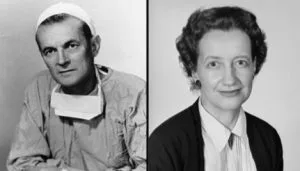
Declarative memory is memory for facts and events — the things you can consciously bring to mind and put into words: a vocabulary item, a grammar rule, what you had for breakfast. Procedural memory is memory for skills — how to do something, expressed in the doing rather than in words: riding a bike, touch-typing, or speaking your native language fluently without thinking about it. The shorthand is knowing-that versus knowing-how. These are not two labels for one thing; they are two distinct systems in the brain, and the single most dramatic piece of evidence for that separation came from one patient in the 1950s.
That separation matters for anyone learning a language, because a language lives in both systems at once. The words and rules you can recite start out as declarative knowledge; genuine fluency is a procedural skill. Understanding how the brain moves knowledge from the first to the second is, in effect, a map of what practice is actually for.
The case of H.M. (1957)
In 1953 a young man with severe, treatment-resistant epilepsy underwent brain surgery. The neurosurgeon William Beecher Scoville removed structures on both sides of his medial temporal lobe — including most of the hippocampus and the amygdala — in an attempt to stop his seizures. The seizures did ease. But the operation left him with a profound and permanent side effect that would make him the most studied patient in the history of neuroscience. To protect his privacy he was known for decades only by his initials, H.M.; his name, Henry Molaison, was made public only after his death in 2008.
Working with the neuropsychologist Brenda Milner, Scoville documented what had happened, and in 1957 they published the results in a paper — Loss of recent memory after bilateral hippocampal lesions — that became a landmark. H.M. had developed severe anterograde amnesia: he could no longer form new long-term memories for facts or events. He could hold a thought for as long as he kept rehearsing it, so his short-term memory was intact, and his memories from well before the surgery were largely preserved. But the moment his attention moved on, a new experience was gone for good. He would read the same magazine as if for the first time, and had to be reintroduced to Milner at every session over years of testing.
The clean, localized nature of the damage is what made the case so revealing. It showed that the medial temporal lobe, and the hippocampus in particular, is essential for turning fleeting experience into durable declarative memory — and, crucially, that this machinery is separate from the parts of the brain that hold short-term thought and old knowledge. Damage one and you can leave the others standing.
The two memories: what H.M. could still learn
The truly decisive finding came next. In experiments beginning in the early 1960s, Milner gave H.M. a mirror-drawing task: he had to trace the outline of a star while seeing only its reflection in a mirror, which reverses every movement and is clumsy and frustrating at first. Over three days of practice H.M. got steadily better — faster, with fewer errors — improving from one day to the next exactly as a healthy person would. Yet each day he insisted he had never done the task before and had no memory of the previous sessions.
Here was the dissociation in its purest form. H.M. could not form a new declarative memory of having practised — that depended on the hippocampus he no longer had — but he could still form the procedural memory of the skill itself, because that relies on other structures (the basal ganglia and cerebellum) left untouched by his surgery. Knowing-that and knowing-how had been physically pried apart in a single person. This is the strongest kind of evidence in neuroscience: not a correlation, but a double reality in which one capacity is destroyed while the other is preserved.
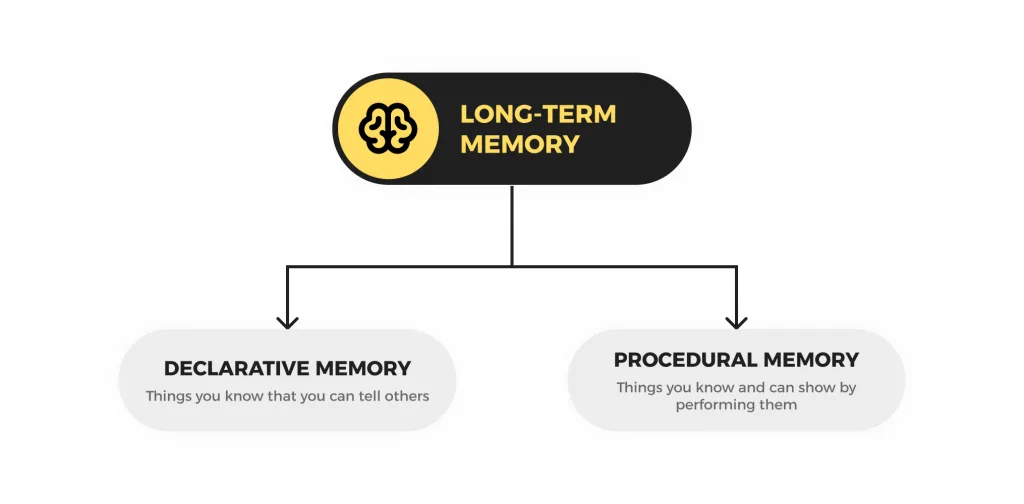
Over the following decades the neuroscientist Larry Squire built these findings into the taxonomy of long-term memory that is still standard today. It splits long-term memory into two branches:
- Declarative memory (also called explicit memory — it is conscious). It divides in turn into episodic memory, for personal events located in time and place ("the café where I first ordered a coffee in Italian"), and semantic memory, for general facts stripped of their context ("caffè means coffee"). This branch is what H.M. lost.
- Non-declarative memory (also called implicit memory — it operates without conscious awareness). Its best-known member is procedural memory for motor and cognitive skills, alongside priming, classical conditioning and simple non-associative learning. This branch is what H.M. kept.
A note on terminology, because the two pairs are often confused: declarative = explicit = conscious, and procedural is one kind of implicit, unconscious memory. Riding a bike is the classic illustration — procedural memory carries out the balancing and pedalling without a word of conscious instruction, while declarative memory holds the route you plan to take. You can lose one and keep the other, which is precisely why they are counted as separate systems.
Ullman's declarative/procedural model for language
The most influential attempt to map this distinction directly onto language is the declarative/procedural (DP) model, developed by the neuroscientist Michael Ullman (Nature Reviews Neuroscience, 2001; Cognition, 2004). Its central claim is elegant: the two great components of language rest on the two memory systems.
- The mental lexicon — your store of words and their meanings, and the irregular, memorized odds and ends of a language (irregular past tenses like went, fixed idioms) — depends on declarative memory, rooted in the temporal lobe. Words are facts, and facts are learned declaratively.
- The mental grammar — the rule-governed machinery that combines words into sentences, the regular patterns you apply on the fly (adding -ed, ordering words correctly) — depends on procedural memory, rooted in frontal-lobe and basal-ganglia circuits, the same networks that support motor skills.
The model makes a prediction that every adult learner recognizes. Early on, a second language leans heavily on declarative memory: you memorize vocabulary and consciously apply rules you could recite from a textbook. That is slow and effortful, because you are, in effect, computing each sentence by hand. Fluency arrives when the grammar migrates into the procedural system and runs automatically — the point at which you stop reciting the rule and simply speak. The DP model also explains why children, whose procedural systems are especially plastic, absorb grammar so effortlessly, and why adults often lean on declarative memory to compensate.
What this means for learning a language
The practical lesson is that learning a language is the job of moving knowledge from the declarative system into the procedural one — from knowing-that to knowing-how. In second-language research this process has a name: proceduralization. Robert DeKeyser's skill-acquisition theory describes it as three stages — a declarative stage (you learn the rule), a procedural stage (repeated meaningful practice turns the rule into a smooth routine), and an automatic stage (the routine runs fast, accurately and without conscious effort). Crucially, only the first stage is quick; the shift into procedural, automatic knowledge is the slow part, and it is driven by one thing above all: practice.
That reframes what "study" should look like:
- Declarative knowledge is the start, not the finish. Memorizing a grammar table is worth doing, but a rule you can recite is not yet a skill you can use. It has to be exercised in real production before it proceduralizes.
- Practice in whole, meaningful sentences. Grammar becomes procedural through use, not through more explanation — which is why the Taalhammer method drills complete sentences you actually produce, rather than isolated words and rules.
- Space the practice, and let sleep do its part. Both branches of memory are strengthened by retrieval over time rather than by cramming. Combine deliberate spaced repetition with good sleep, which drives the overnight memory consolidation that stabilizes new words and skills alike.
- Expect fluency to feel sudden after a long build-up. That is proceduralization crossing a threshold — the accumulated practice finally running as an automatic routine rather than a conscious computation.
H.M. lost the ability to add to his declarative memory but kept learning new skills to the end of his life. For a healthy learner the point is the mirror image of his tragedy: the goal is to keep feeding the declarative system with words and rules, and then to convert them, through steady practice, into the procedural fluency that lets you speak a language as effortlessly as you ride a bike.
Frequently asked questions
What is the difference between declarative and procedural memory?
Declarative memory stores facts and events you can consciously recall and state in words — vocabulary, grammar rules, what happened yesterday. It is "knowing-that". Procedural memory stores skills you perform without conscious recall — riding a bike, typing, speaking fluently. It is "knowing-how". They are separate brain systems: declarative memory depends on the hippocampus and temporal lobe, procedural memory on the basal ganglia and cerebellum, which is why brain damage can wipe out one while leaving the other intact.
What did patient H.M. teach us about memory?
After surgery removed his hippocampus on both sides in 1953, Henry Molaison (H.M.) could no longer form new declarative memories — he forgot every new fact and event within moments. But he could still learn new motor skills, such as mirror-drawing, improving day by day even though he had no memory of ever practising. That contrast proved that declarative and procedural memory are physically distinct systems, one of the foundational discoveries of modern neuroscience, documented by Scoville and Milner in 1957.
How does this apply to learning a language?
Words and grammar rules begin as declarative knowledge — memorized facts you apply consciously and slowly. Fluency is a procedural skill that runs automatically. Learning a language is essentially the process of moving grammar and vocabulary from the declarative system into the procedural one, called proceduralization, and it happens through meaningful practice over time — not through more explanation. That is why practising full sentences, spacing your reviews and sleeping well matter more than memorizing rules alone.
Sources
- Scoville, W. B., & Milner, B. (1957). Loss of recent memory after bilateral hippocampal lesions. Journal of Neurology, Neurosurgery & Psychiatry, 20(1), 11–21.
- Corkin, S. (2002). What's new with the amnesic patient H.M.? Nature Reviews Neuroscience, 3(2), 153–160 — reviews Milner's mirror-drawing experiments and H.M.'s preserved motor-skill learning.
- Squire, L. R. (2004). Memory systems of the brain: A brief history and current perspective. Neurobiology of Learning and Memory, 82(3), 171–177.
- Ullman, M. T. (2004). Contributions of memory circuits to language: The declarative/procedural model. Cognition, 92(1–2), 231–270.
- DeKeyser, R. M. (2020). Skill acquisition theory. In B. VanPatten, G. D. Keating, & S. Wulff (Eds.), Theories in Second Language Acquisition: An Introduction (3rd ed., pp. 83–104). Routledge.