Pirahã language: Daniel Everett an why language is a cultural invention (2017)
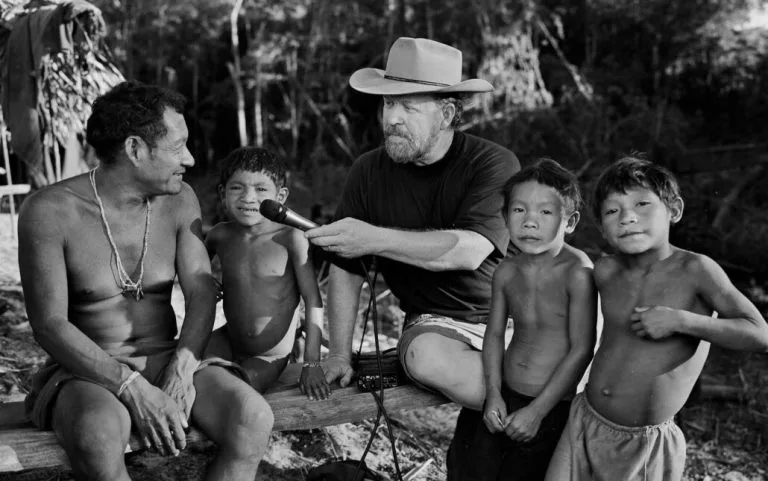
Pirahã is the language of a small hunter-gatherer people on the Maici River in the Brazilian Amazon, and for two decades it has been at the centre of the fiercest dispute in modern linguistics. Its best-known student is the American linguist Daniel Everett (born 1951), who arrived in the 1970s as a Christian missionary, stayed as a field linguist, and eventually concluded that Pirahã lacks features long thought to be universal to human language — above all recursion, the ability to embed one phrase inside another without limit. From that observation Everett built a large claim: that language is not a biological instinct wired into the species, as Noam Chomsky’s nativism holds, but a cultural invention — a tool a community builds to solve its own problems. The claim is still contested, but the argument it started has never gone away.
The people and their language
The Pirahã (pronounced roughly pee-da-HAN) number a few hundred people — most estimates put the language’s speakers at around 250 to 400 — living in small villages along the Maici, a tributary of the Amazon in the state of Amazonas. The community is largely monolingual: most Pirahã speak little or no Portuguese, and the language shows no sign of dying out. Pirahã is the last surviving variety of the Mura language family; every related dialect has already disappeared, which leaves it with no living relatives to compare it against.
What drew Everett’s attention were the things Pirahã appears to do without. By his account it has no fixed words for exact numbers — only rough terms for “a small amount” and “a larger amount” — and no words for abstract colours, only descriptive phrases. It has, he argues, no perfect tense and no deep grammatical embedding: thoughts are strung together in short, sequential clauses rather than packed into one nested sentence. Everett ties all of this to a single cultural principle he calls the immediacy of experience — Pirahã talk, he claims, is anchored to what the speaker or a living witness has directly seen. A famous illustration: one way to say “good night” is “don’t sleep, there are snakes,” the phrase that gave his 2008 book Don’t Sleep, There Are Snakes its title. It also, on his account, explains why the Pirahã were unmoved by the Bible stories that had brought him there — a story about events no living person had witnessed simply did not fit how their language talks about the world.
Everett’s thesis versus Chomsky’s recursion
What made this more than an interesting ethnographic footnote was its timing. In a much-cited 2002 paper, Chomsky, Marc Hauser and Tecumseh Fitch had argued that after everything else is stripped away, the one component that may be truly unique to human language is recursion — the capacity to nest structures inside structures, so that “the man is happy” can become “the dog the man who is happy owns is barking.” On the strongest reading, recursion is the language faculty. Everett’s 2005 paper in Current Anthropology, “Cultural Constraints on Grammar and Cognition in Pirahã,” aimed straight at that claim: if a fully human language can get by without recursion, then recursion cannot be a biologically fixed universal, and the whole picture of an innate grammar shared by every language is in trouble.
The deeper move is about the direction of causation. For Chomsky, grammar is a property of the mind that culture decorates but does not create. For Everett, the arrow runs the other way: the shape of Pirahã grammar follows from the culture, so language is something a community makes, the way it makes canoes or fishing techniques. On this view there is no special “language instinct” and no universal grammar underneath the variety — only a general-purpose human mind putting a communicative tool together out of what its life requires.
Counterarguments and the state of the dispute
Everett’s claim was challenged hard, and the challenge has not been settled. The most detailed reply came from Andrew Nevins, David Pesetsky and Cilene Rodrigues, whose 2009 paper in Language, “Pirahã Exceptionality: A Reassessment,” argued two things: that Everett’s own earlier grammatical work described Pirahã constructions that look like embedding, and that most of the features he highlights turn up in ordinary languages whose speakers have none of the cultural restrictions he invokes. In short, they said, the data do not support the exceptional reading, and where Pirahã is unusual it is unusual in familiar ways. Everett answered in the same issue, defending his description and his cultural explanation.
A separate strand tested the numbers claim experimentally rather than grammatically. Michael Frank, Everett and colleagues reported in Cognition in 2008 that Pirahã speakers, asked to match quantities they could see, performed well on small sets but grew inexact with larger ones — consistent with a language that has no exact number words. Their conclusion was carefully worded: words for exact number are a cognitive technology, a cultural invention for tracking quantity, not a built-in universal. That result is about counting, not about recursion, and it is worth keeping the two debates apart: the number data are widely accepted, while the recursion claim remains the genuinely disputed core.
Part of what keeps the argument alive is that it is hard to referee. Pirahã has very few fluent outside analysts, no close living relatives, and a grammar deeply entangled with a way of life that is itself changing. Claims about what the language cannot do are claims about absence, which are always harder to prove than presence.
What this means for linguistics
Whichever way the Pirahã case finally resolves, it sharpened a question the field now takes seriously: how much of grammar is fixed biology and how much is built from culture and use. It gave field linguistics new weight against the armchair — a single well-documented language became a test case that theory had to answer to. And it fed the broader shift away from the strongest versions of universal grammar toward accounts in which powerful general learning, communication and culture do more of the work. Pirahã did not by itself overturn nativism, but it made “all human languages share a fixed grammatical core” a claim that has to be argued for rather than assumed. (The separate, mathematical sense in which Chomsky ranked grammars by power is covered in the entry on the Chomsky hierarchy.)
What this means for learning a language
The Pirahã debate is about how the first language grows in a child, not about adult study — but it carries one clear lesson for learners. Everett’s whole case is that a language is shaped by, and inseparable from, the life and culture it serves; even his critics agree that grammar is learned from real utterances met in real situations, not from a table of rules. Both sides, in other words, point the adult learner in the same practical direction: learn a language inside its contexts, from whole meaningful sentences you actually use, rather than as an abstract system memorised in the void. That is exactly the principle behind sentence-based learning with active recall — grammar internalised from utterances met and produced repeatedly, with explicit rules as a support rather than the starting point. Whether the human language capacity turns out to be a dedicated instinct or a cultural achievement, the thing you are actually acquiring is a set of sentences tied to meanings — and meanings live in context.
FAQ
What is the Pirahã language?
Pirahã is the language of a few hundred hunter-gatherers on the Maici River in the Brazilian Amazon. It is the last surviving variety of the Mura family and has no living related languages. It became famous through Daniel Everett, who argued that it lacks recursion, exact number words and abstract colour terms, and that its grammar is tightly bound to direct, witnessed experience.
Why is Pirahã so controversial?
Because Everett used it to challenge the idea, central to Chomsky’s later work, that recursion is a universal, biologically given feature of all human language. If a full human language can function without recursion, that universal collapses — so his 2005 claim struck at the heart of nativist theory. Other linguists (Nevins, Pesetsky and Rodrigues, 2009) dispute the data, and the recursion question remains unresolved.
What does “language is a cultural invention” mean?
It is Everett’s alternative to the view that language is an innate instinct. On his account language is a tool a community builds to solve its communicative problems, so its structure reflects the culture that made it rather than a fixed grammar in the brain. It is the opposite pole to nativism and universal grammar, and the debate between the two is still open.
Sources
- Daniel L. Everett, “Cultural Constraints on Grammar and Cognition in Pirahã”, Current Anthropology 46 (2005): 621–646.
- Michael C. Frank, Daniel L. Everett, Evelina Fedorenko, Edward Gibson, “Number as a cognitive technology: Evidence from Pirahã language and cognition”, Cognition 108 (2008): 819–824.
- Andrew Nevins, David Pesetsky, Cilene Rodrigues, “Pirahã Exceptionality: A Reassessment”, Language 85 (2009): 355–404.
- Daniel L. Everett, “Pirahã Culture and Grammar: A Response to Some Criticisms”, Language 85 (2009): 405–442.
- Daniel L. Everett, Don’t Sleep, There Are Snakes: Life and Language in the Amazonian Jungle, Pantheon, 2008.