Language is innate: Nativism and Noam Chomsky (1950)
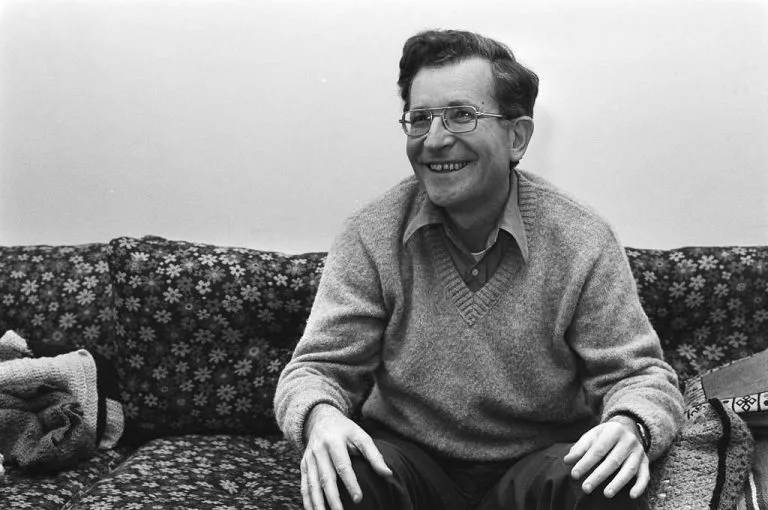
Nativism is the theory that the human capacity for language is innate: children are born with a biological endowment specialised for acquiring language, rather than learning it from scratch the way they learn to play chess or ride a bicycle. The position is associated above all with the American linguist Noam Chomsky (born 1928), who developed it from the 1950s onwards — first in his early work on generative grammar, then, most famously, in his 1959 demolition of Skinner’s behaviorist account of language, which had treated speaking as a set of habits built by imitation and reinforcement. Against that view, Chomsky argued that language is not a cultural artefact like table manners but part of human biology, as characteristic of our species as walking upright. Nativism became the founding doctrine of modern linguistics and one of the central battlegrounds of cognitive science — and, unlike the argument against behaviorism, this second argument is still not settled.
The poverty of the stimulus
The core argument for nativism is known as the poverty of the stimulus (Chomsky coined the phrase in Rules and Representations, 1980, but the argument runs through his work from the 1959 Skinner review onwards). It starts from an observation about the input children receive: everyday speech is a limited and imperfect sample — full of false starts, fragments and errors — and parents rarely correct grammar explicitly, so the child gets little “negative evidence” about which sentences are impossible. Yet every typically developing child, in every culture, converges on a rich and largely uniform grammar within a few years, without instruction and regardless of intelligence.
Chomsky’s favourite illustration is structure dependence. To turn “The man is tall” into a question, English moves the verb: “Is the man tall?”. A learner generalising from such simple pairs might conclude: move the first verb-like word to the front. That rule fails on “The man who is tall is happy” — the correct question is “Is the man who is tall happy?”, not “Is the man who tall is happy?”. Children essentially never make the second kind of error, even though the sentences that would distinguish the two hypotheses are vanishingly rare in what they hear. If the data do not determine the grammar, the argument goes, something in the child must be constraining the hypotheses in advance — and that something is innate.
The LAD and Universal Grammar
Chomsky gave the innate endowment two names, which describe two sides of the same idea (both worked out in detail in Aspects of the Theory of Syntax, 1965).
- The Language Acquisition Device (LAD) is the hypothesised mental mechanism that takes raw speech as input and delivers a grammar as output. It is not a physical organ that can be pointed to in the brain, but a functional description of whatever it is that lets a two-year-old do what no explicit teaching achieves.
- Universal Grammar (UG) is the content of that endowment: the set of principles and structural options claimed to be common to all human languages — the reason why the world’s languages, for all their surface variety, seem to draw on the same underlying design. On this view a child does not learn language from zero; it selects, from a constrained innate space, the particular grammar that fits the speech around it.
A classic way to picture the pair: Universal Grammar is the record, and the LAD is the needle that plays it — the stored structure is useless without the mechanism, and the mechanism has nothing to do without the structure. The theory itself kept evolving: in the 1980s UG was formulated as a system of universal principles with binary parameters set by experience (the “principles and parameters” framework), and from the 1990s Chomsky’s Minimalist Program pared the innate core down to very little — in a much-cited 2002 paper with Marc Hauser and Tecumseh Fitch, essentially to recursion, the ability to embed structures inside structures without limit. (Chomsky’s separate, earlier mathematical classification of grammars is covered in the entry on the Chomsky hierarchy.)
Criticism and the state of the debate
Nativism won its first war decisively: after 1959, virtually no one defended the claim that language is nothing but conditioned habit. But the positive claim — that the language faculty is innate and language-specific — has been under sustained attack since the 1990s, from three directions.
Statistical learning. In a landmark 1996 experiment in Science, Jenny Saffran, Richard Aslin and Elissa Newport showed that eight-month-old infants can segment words out of a continuous stream of nonsense syllables after just two minutes of passive listening, purely by tracking which syllables predict which. Infants, in other words, are far more powerful general-purpose learners than the poverty-of-the-stimulus argument assumed — the stimulus is richer, and the learner stronger, than Chomsky’s 1960s picture allowed.
Usage-based theory. Michael Tomasello (Constructing a Language, 2003) argued that language acquisition needs no language-specific endowment at all: children build their grammar bottom-up from concrete phrases they have actually heard, using two general human capacities — reading intentions (understanding what others are trying to communicate) and finding patterns. On this account, grammar is not selected from an innate menu; it emerges, construction by construction, from use.
The universals themselves. If UG exists, all languages should show its signature. Field linguists have questioned this: the most famous case is Daniel Everett’s 2005 claim that Pirahã, an Amazonian language, lacks recursion — precisely the property Minimalism had made the core of the language faculty. The Pirahã data remain fiercely contested, but they crystallised a broader worry, stated bluntly in Ewa Dąbrowska’s 2015 review: there is little agreement on what exactly Universal Grammar contains, and the direct evidence for any specific version of it is weak.
Where does the dispute stand? Genuinely unresolved. Most researchers accept that something about human biology makes language possible for us and not for chimpanzees; the live question is whether that something is a dedicated grammar module (nativism proper) or a bundle of more general capacities — powerful statistical learning, intention-reading, a memory suited to hierarchical patterns — that only together make language inevitable. Generative linguists continue to defend structure-dependence and the poverty of the stimulus with formal learnability arguments; their critics continue to show how much of grammar can be learned from data alone, an argument lately sharpened by large language models that acquire impressive syntax with no built-in grammar (though on vastly more input than any child receives).
The legacy of nativism
Whatever the final verdict on Universal Grammar, nativism transformed the study of language and the mind. It put the inner structure of the mind back at the centre of psychology after half a century of behaviorism, and became a founding pillar of the cognitive revolution. It created language acquisition as a research field: the modern experimental study of what infants know and when — including the statistical-learning work that now challenges it — exists because Chomsky made the child’s achievement look astonishing and worth explaining. And it shaped theories of second-language learning: Stephen Krashen’s influential distinction between unconscious acquisition and conscious learning, with the claim that real fluency comes only from the former, is nativist thinking applied to the classroom. Chomsky’s wider influence on how foreign languages are taught is treated in a separate entry on Noam Chomsky and his influence on foreign language learning.
What this means for learning a language
Nativism concerns first-language acquisition in children, and its lesson for adult learners is indirect but real. First, the encouraging part: whichever side of the debate is right, every human brain demonstrably comes equipped to handle language — there is no such thing as a person constitutionally unable to learn one. Second, both camps agree on what the learning mechanism feeds on: massive exposure to meaningful sentences. Children do not acquire grammar from rules and tables; they acquire it from utterances, whether an innate device is generalising over them or a statistical learner is extracting their patterns. For an adult learner the practical conclusion is the same — grammar is internalised fastest from whole sentences met and produced repeatedly in context, with explicit rules as a support rather than a starting point, which is the principle behind sentence-based learning with active recall. And third, the honest caveat: adults are not children. Whatever window of effortless acquisition the child’s brain enjoys, adult learning leans more on attention, memory and deliberate practice — which is why method matters for adults in a way it never does for a three-year-old.
FAQ
What is nativism in one sentence?
Nativism is the theory, associated above all with Noam Chomsky, that humans are born with an innate, biologically given capacity for language — so children do not learn their mother tongue from experience alone, but develop it the way they develop walking, guided by inborn structure.
What is the difference between the LAD and Universal Grammar?
Universal Grammar is the innate content — the principles and structural options claimed to be shared by all human languages — while the Language Acquisition Device is the innate mechanism that uses that content to turn the speech a child hears into a full grammar. In Chomsky’s classic picture, UG is the record and the LAD is the needle that plays it.
Is Chomsky’s nativism still accepted today?
It is still influential but no longer dominant. Statistical-learning experiments (Saffran and colleagues, 1996), Tomasello’s usage-based theory (2003) and field data such as Everett’s work on Pirahã (2005) have convinced many researchers that general learning abilities explain more of acquisition than Chomsky assumed. Most agree something about human biology is special for language; whether it is a dedicated grammar module remains an open question.
Sources
- Noam Chomsky, “A Review of B. F. Skinner’s Verbal Behavior”, Language 35 (1959): 26–58.
- Noam Chomsky, Aspects of the Theory of Syntax, MIT Press, 1965.
- Jenny R. Saffran, Richard N. Aslin, Elissa L. Newport, “Statistical Learning by 8-Month-Old Infants”, Science 274 (1996): 1926–1928.
- Michael Tomasello, Constructing a Language: A Usage-Based Theory of Language Acquisition, Harvard University Press, 2003.
- Daniel L. Everett, “Cultural Constraints on Grammar and Cognition in Pirahã”, Current Anthropology 46 (2005): 621–646.
- Ewa Dąbrowska, “What exactly is Universal Grammar, and has anyone seen it?”, Frontiers in Psychology 6 (2015): 852.