Synapse: How We Tested It and Why You Set the Desired Retention
Synapse is the new algorithm that decides when a card comes back for review in Taalhammer. Before it scheduled a single review for anyone, we fitted it to our learners' past answers. Then we checked its predictions on answers it had never seen. It beat our old algorithm on all three measures we use. Testers can now also set its desired retention: how much of what comes back you should still remember. This article shows how we tested it and how to pick that setting.
Contents
Atom and Synapse
From 2019 our scheduling algorithm has been called Atom. It has planned every review in Taalhammer since then, and it's still the default.
Synapse is its successor. Atom follows a fixed recipe. Each correct answer multiplies the interval by a factor that depends on how easy the card has been so far. Synapse keeps a small model of your memory for every card instead. It predicts how likely you are to remember the card on any given day. That's why we could test it the way we describe below: a prediction can be checked against what you actually did.
How we tested it before anyone used it
A new scheduler is a risky thing to try on people. If it's wrong, you find out weeks later, when cards you should have reviewed have slipped away. So we tested it on the past first.
The data. Our review log holds every answer with a timestamp. A card here means one learner, one sentence, one direction. For each card, the first 80% of its answers went into training and the last 20% into the test. The split follows time, so the model never learns from the future it has to predict. We scored only real memory tests: a card shown again after a gap. First encounters, same-day drills and info screens you only read didn't count towards the score.
The fit. Synapse has 21 numbers that describe how memory behaves. We fitted them to our learners' answers. The defaults come from other people's flashcards.
The test. For each of the 226,710 test answers, both algorithms gave a probability that you would remember the card. Then we compared those probabilities with what actually happened.
| Measure | What it asks | Synapse | Atom |
|---|---|---|---|
| AUC (higher is better) | Does it know which cards you'll forget? | 0.686 | 0.597 |
| Calibration error (lower is better) | When it says 80%, do you remember 80%? | 0.098 | 0.250 |
| Log loss (lower is better) | How badly is it punished for confident mistakes? | 0.43 | 0.59 |
Synapse fitted to our learners also beat Synapse with default numbers on every measure. Learning from our own learners paid off. The gap in log loss isn't luck either. Across 1,000 resamples of the test set, the difference stayed between −0.179 and −0.148, never near zero.
What AUC, calibration and log loss actually measure
AUC is a ranking test. Take one card you remembered and one you forgot, at random. AUC is the chance the algorithm gave the forgotten card the lower probability. A coin flip scores 0.5; a perfect ranking scores 1.0. This one matters most. A scheduler's job is to bring back the cards you're about to forget, not the ones you're sure of.
Calibration checks whether the percentages are honest. Group every prediction of "about 80%" and count how many of those cards you really remembered. If it's 80%, the algorithm is well calibrated. Atom was typically off by about 25 percentage points; Synapse by about 10. The retention setting below depends on this. If the algorithm can't tell 80% from 90%, a dial with those numbers on it is decoration.
Log loss punishes confident mistakes hard. Saying "99% sure" about a card you forgot costs far more than saying "60%". It's the standard measure, and it's the one that can mislead you here.
Our learners remember about 89% of the cards that come back for review. Picture a "model" that ignores the card and always answers "89%". Its log loss is 0.23, better than both real algorithms. Its AUC is exactly 0.5, because it can't tell one card from another. When nearly every answer is "remembered", guessing the average is cheap, and log loss rewards it. That's why we trust AUC and calibration first and read log loss only next to them.
Eight weeks in the shadow, then real learners
A test on old answers can't show what happens once the algorithm's own schedule decides when you see a card. So next, Synapse ran on our servers for eight weeks without showing anyone anything. For every real answer it computed its own schedule next to Atom's. On 164,894 answers from 1,482 learners its AUC was 0.749, against Atom's 0.604.
From 29 September 2026, about 1,358 learners were split into two groups at random. Half got Synapse, half stayed on Atom. The target was 82.5%. The first reading came on 19 October, over 1,000 cards that had come back twice. Learners actually remembered 83.2%, within one percentage point of the target.
What we haven't measured yet. Those 1,000 cards were all young, with a typical stability of about a day and a half. Cards you've known for months come back after months. A three-week test can't see them yet. That's the biggest open question, and it's why Atom stays the default.
What we got wrong. The test also caught a bug. Say you answered a new card for the second time a few minutes short of 24 hours after the first. Synapse treated that as a same-day repeat, and the next review could jump about two months ahead. We fixed it on 25 October 2026 and recalculated the 4,017 cards it had affected. If Synapse once felt too bold with a fresh card, this was probably why.
Why you can set the desired retention
Desired retention is the share of cards you should still remember when they come back. Synapse picks each review date so that your chance of recall on that day has dropped to this target. Higher means you see cards sooner and more often. Lower means fewer reviews and more room for new phrases.
It sounds as if higher is always better. It isn't.
- Set it too high and you review the same cards over and over. A review strengthens memory most when you've almost forgotten and have to work to recall. A card you'd remember easily anyway costs you a minute and teaches little. Psychologists call that useful effort a desirable difficulty. Studies of spacing find that longer gaps, up to a point, give better long-term memory (Cepeda et al., 2008).
- Set it too low and cards slip away. Forget too many and each review turns into relearning from scratch. That costs more than the reviews you saved.
The workload isn't linear either. The Anki manual warns that above 90% "the workload increases very quickly" (Anki manual). Our own numbers agree.
Why 82.5% is the default
The default sits in the middle. When we replayed past answers, Synapse turned out slightly pessimistic. At a target of 80%, our learners actually remembered about 88.5%. At 82.5%, real recall comes out near 90%, which is where most spacing advice lands.
What each step does
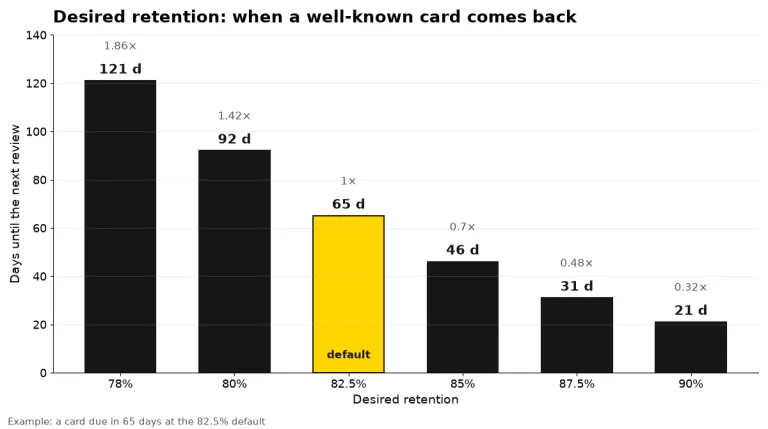
The table shows how much later or sooner a card you already know well comes back at each step. The example is a card due in 65 days at the default.
| Desired retention | Interval vs default | That card returns in |
|---|---|---|
| 78% | 1.86× | about 121 days |
| 80% | 1.42× | about 92 days |
| 82.5% (default) | 1× | 65 days |
| 85% | 0.70× | about 46 days |
| 87.5% | 0.48× | about 31 days |
| 90% | 0.32× | about 21 days |
We left out the extremes on purpose. At 95% that same card would come back after about 8 days (0.12×). A sentence you know cold would return every week. At 75% it would wait 2.8 times longer than the default, and too many cards would be lost. Each of the six steps keeps a card between a quarter and twice its default interval.
What the setting doesn't change
- New cards and wrong answers. The first learning steps and a review after a mistake come back the next day, whatever you choose. The setting acts on cards you've already learned.
- Your existing queue. It applies from each card's next review. We don't recalculate everything at once: turning the dial up would bury you in overdue cards on a single day.
- "Almost" still counts as remembered. If you'd rather see young cards more often, turn the dial up a step.
How to try it
Synapse is open to a small group of testers. If you're one of them, you'll find it in Settings → Learn, with the retention steps underneath. You can switch back to Atom at any time. Both keep your progress. A switch is spread over a few days, so you won't get a flood of reviews.
Tell us how it feels at [email protected]. The numbers above come from your answers, and so will the next version of Synapse.
For the idea of spacing itself, start with spaced repetition and the forgetting curve.
FAQ
What is desired retention?
It's the share of cards you should still remember when they come back for review. Synapse picks each review date so that your chance of recall on that day equals this target. Higher means more reviews and stronger memory. Lower means fewer reviews and more time for new material.
What desired retention should I choose?
Start with the default, 82.5%. In practice it gives about 90% real recall. Move up a step if too many cards feel forgotten when they return. Move down a step if reviews feel like repeating things you know well. Give each change a couple of weeks, since it works from each card's next review.
Is Synapse better than Atom?
On our learners' past answers it predicted forgetting better on every measure we use. In the live test, real recall landed within a point of the target. We haven't yet seen how it handles cards known for months, so Atom stays the default until we have.