Desirable difficulties: Robert A. Bjork (1994)

Desirable difficulties are learning conditions that make practice slower and more error-prone in the moment, yet measurably improve long-term retention and transfer. The term was coined by Robert A. Bjork, a cognitive psychologist at UCLA, in a 1994 chapter titled “Memory and metamemory considerations in the training of human beings”; the underlying theory was developed together with Elizabeth Ligon Bjork. Its central claim is deliberately counter-intuitive: the manipulations that impede performance during practice — spreading sessions out, mixing topics, testing yourself instead of re-reading — are often exactly the ones that produce durable learning, while the manipulations that make practice smooth and rapid tend to produce learning that evaporates.
The theory rests on a distinction that sounds obvious and is routinely ignored: learning versus performance. Performance is what can be observed and measured during or immediately after practice. Learning is the relatively permanent change in knowledge or skill that remains once the session is long over. Decades of experiments — reviewed by Soderstrom and Bjork (2015) — show that the two can dissociate completely: current performance is a poor and often actively misleading index of learning. A learner can improve rapidly while acquiring almost nothing durable, and can appear to struggle while building precisely the memories that will last.
Bjork and the new theory of disuse
Why should difficulty help? Bjork’s answer is the new theory of disuse, formulated with Elizabeth Bjork in 1992 — the name is a nod to, and a rejection of, Thorndike’s old “law of disuse”, which held that unused memories simply decay away. The new theory gives every item in memory two independent strengths. Storage strength measures how well the item is entrenched — how richly it is connected to everything else you know. Retrieval strength measures how accessible the item is right now. Only retrieval strength shows up in performance; only storage strength constitutes learning.
Two properties of the model do most of the work. First, storage strength, once accumulated, is never lost: what we experience as forgetting is a loss of retrieval strength — of current access — not an erasure. Second, and crucially, the strengths interact in reverse: the lower an item’s retrieval strength at the moment of a successful retrieval, the greater the resulting gain in storage strength. Recalling a word you rehearsed a minute ago adds almost nothing; recalling the same word at the brink of forgetting produces the deepest consolidation available. In Bjork’s formula, forgetting is the friend of learning — losing access is the very condition that makes the next act of remembering potent. This is also the theoretical reason why spaced repetition schedules each review as close as it dares to the point of forgetting.
A catalogue of desirable difficulties
Bjork’s 1994 chapter did not stop at theory: it listed concrete manipulations, each of which now carries its own experimental literature. The five below are the best documented, each with what it looks like when the material is a language.
Spacing
Distributing practice over time instead of massing it into one block is the oldest and most robust difficulty of all — the underlying spacing effect was measured by Ebbinghaus in 1885, and the technique built on it has its own history. Massed practice yields fast, fluent performance that decays steeply; spaced practice yields slower, more frustrating gains that persist. For vocabulary this means that three sessions of twenty minutes across a week beat a single hour, and that a review postponed until the word has begun to fade does more than a review taken while it is still easy.
Retrieval practice: the testing effect
A test is not just a measurement — it is a learning event, and a stronger one than re-exposure. In the classic experiment by Roediger and Karpicke (2006), students either re-read a text four times or read it once and recalled it three times. Five minutes later the re-readers were ahead, 83% to 71%. One week later the result had reversed dramatically: those who had practised retrieval recalled 61% of the material, the re-readers 40%. In language learning the prescription is blunt: cover the answer and produce the word or the whole sentence from memory before checking — re-reading a vocabulary list is close to doing nothing.
Interleaving
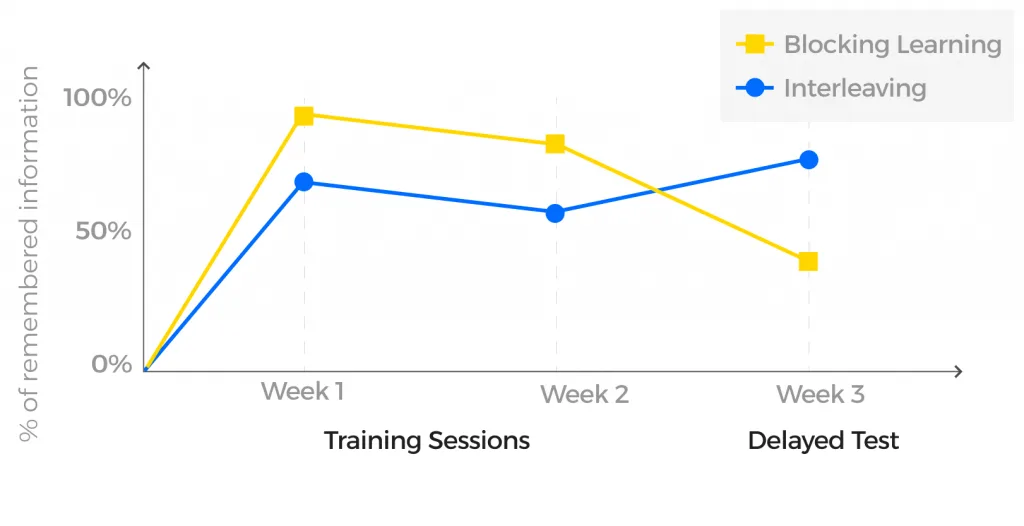
Practising topics in a mixed order instead of one block at a time slows you down and improves you. When Rohrer and Taylor (2007) shuffled mathematics practice problems, accuracy during practice dropped from 89% to 60% — and accuracy on a test a week later rose from 20% to 63%. Kornell and Bjork (2008) found the same for a perceptual skill (recognizing painters’ styles): interleaving beat massing, while most participants remained convinced the opposite had happened. For a language, interleave instead of drilling in blocks: mix new words with old ones, mix tenses within one session, mix grammar with vocabulary — the extra effort of switching and discriminating is where the learning lives.
Generation
Material you produce yourself, even partially, is remembered better than material handed to you — the generation effect, delineated by Slamecka and Graf (1978): completing “rapid–f___” to fast beats reading “rapid–fast”. For a language learner this is an argument for producing before consuming: attempt the sentence before you hear the model, guess a word’s meaning from context before looking it up, write your own example with a new word instead of copying the dictionary’s.
Varying the conditions of practice
In a study by Kerr and Booth (1978), children practised tossing beanbags at a target either always from three feet, or from two and four feet — never from three. On the final three-foot test the varied group won. Varied practice builds a flexible schema rather than a single groove. The language version: meet the same word in different sentences, spoken by different voices, in different grammatical constructions — not always as the same two-sided flashcard pair — so that the word works everywhere, not only in the context where it was learned.
When difficulty is not desirable
Bjork has insisted from the beginning that difficulties are not desirable per se. A difficulty earns the adjective only under two conditions: the learner must be able to overcome it with effort, and it must engage the very processes the goal requires. A retrieval attempt that never succeeds strengthens little — struggling with material far above your level is an undesirable difficulty, which is why beginners need more support, more successes and shorter intervals than advanced learners.
Arbitrary obstacles fail the second condition. Sans Forgetica, a typeface deliberately designed to be hard to read, was marketed as a memory aid built on desirable difficulties; controlled studies (Taylor et al., 2020) found no memory benefit at all. Disfluency is not a desirable difficulty. The difficulty has to live in the learning process itself — retrieving, producing, discriminating — not in the stimulus being annoying. Desirable difficulty means calibrated challenge, not maximal hardship.
The fluency illusion
The most practical consequence of the learning–performance distinction is metacognitive: we judge how well we have learned by how fluently the material is processing right now. Massed practice, re-reading and blocked drilling all inflate that fluency, so they feel most productive precisely when they teach least. In Roediger and Karpicke’s experiment, participants predicted that re-reading would beat testing — the opposite of what happened a week later. In Kornell and Bjork’s, most participants still rated massing as more effective after interleaving had just won on their own test. Reviews of self-regulated learning (Bjork, Dunlosky and Kornell, 2013) show where this leads: learners systematically choose cramming and re-reading, the most popular and least effective techniques in the literature. The corrective is simple to state: judge your learning by what you can retrieve after a delay, never by how smooth today’s session felt.
What this means for language learning
A language is thousands of small items plus skills of production and discrimination — exactly the kind of material desirable difficulties were described for. Four working rules follow:
- Expect effective practice to feel worse. Slow, effortful sessions with visible errors are the signature of learning, not of failure; effortless streaks are the signature of the fluency illusion.
- Practise retrieval at expanding intervals. Producing words and sentences from memory, timed against the forgetting curve, combines the two strongest difficulties in one procedure — that is exactly what spaced repetition is.
- Mix and vary. Interleave new material with old, and meet each word in many sentences and contexts rather than as one fixed pair.
- Don’t grade yourself on today. What you can recall next week is the measurement that counts; how these principles combine into a complete learning procedure is described in our entry on the method.
Frequently asked questions
What are desirable difficulties in learning?
Desirable difficulties are practice conditions — spacing sessions out, testing yourself, interleaving topics, generating answers, varying contexts — that slow down visible performance during practice but produce more durable and more flexible long-term learning. The term was introduced by Robert A. Bjork in 1994.
Is every difficulty in learning desirable?
No. A difficulty is desirable only if the learner can overcome it with effort and if it engages the processes the goal actually requires. Material far above your level, retrieval attempts that never succeed, or arbitrary obstacles such as hard-to-read fonts are undesirable difficulties — they add strain without adding learning.
Why does easy practice feel more effective than difficult practice?
Because we judge learning by the fluency of current processing — the fluency illusion. Re-reading and massed drilling make material feel familiar and smooth, which the brain misreads as knowledge. Delayed tests reveal the truth: conditions that felt easy tend to produce the steepest forgetting, and conditions that felt hard tend to produce the most durable memory.
Sources
- Bjork, R. A. (1994). Memory and metamemory considerations in the training of human beings. In J. Metcalfe, A. Shimamura (Eds.), Metacognition: Knowing about knowing (pp. 185–205). Cambridge, MA: MIT Press.
- Bjork, R. A., Bjork, E. L. (1992). A new theory of disuse and an old theory of stimulus fluctuation. In A. Healy, S. Kosslyn, R. Shiffrin (Eds.), From learning processes to cognitive processes: Essays in honor of William K. Estes (Vol. 2, pp. 35–67). Hillsdale, NJ: Erlbaum.
- Slamecka, N. J., Graf, P. (1978). The generation effect: Delineation of a phenomenon. Journal of Experimental Psychology: Human Learning and Memory, 4(6), 592–604.
- Kerr, R., Booth, B. (1978). Specific and varied practice of motor skill. Perceptual and Motor Skills, 46(2), 395–401.
- Roediger, H. L., Karpicke, J. D. (2006). Test-enhanced learning: Taking memory tests improves long-term retention. Psychological Science, 17(3), 249–255.
- Rohrer, D., Taylor, K. (2007). The shuffling of mathematics problems improves learning. Instructional Science, 35(6), 481–498.
- Kornell, N., Bjork, R. A. (2008). Learning concepts and categories: Is spacing the “enemy of induction”? Psychological Science, 19(6), 585–592.
- Bjork, E. L., Bjork, R. A. (2011). Making things hard on yourself, but in a good way: Creating desirable difficulties to enhance learning. In M. A. Gernsbacher et al. (Eds.), Psychology and the real world (pp. 56–64). New York: Worth.
- Bjork, R. A., Dunlosky, J., Kornell, N. (2013). Self-regulated learning: Beliefs, techniques, and illusions. Annual Review of Psychology, 64, 417–444.
- Soderstrom, N. C., Bjork, R. A. (2015). Learning versus performance: An integrative review. Perspectives on Psychological Science, 10(2), 176–199.
- Taylor, A., Sanson, M., Burnell, R., Wade, K. A., Garry, M. (2020). Disfluent difficulties are not desirable difficulties: The (lack of) effect of Sans Forgetica on memory. Memory, 28(7), 850–857.