PLATO: The first language learning program (1960)
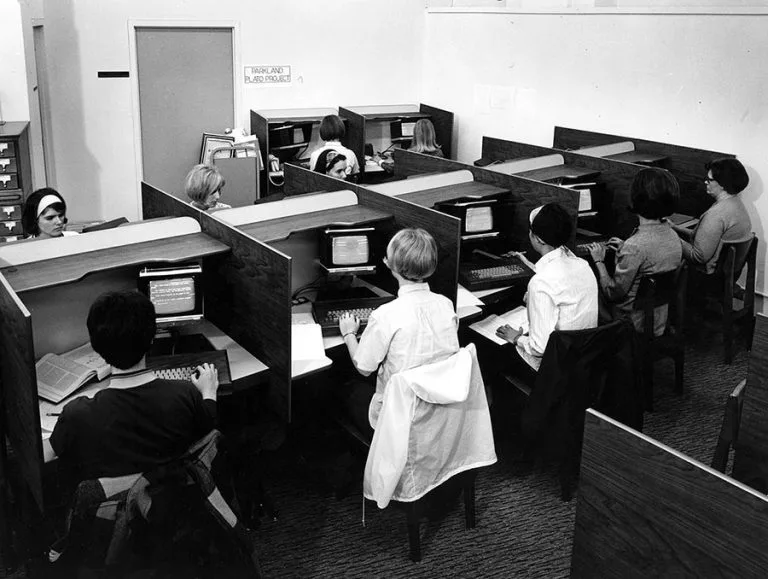
PLATO (Programmed Logic for Automatic Teaching Operations) was a computer-based education system developed at the University of Illinois at Urbana-Champaign, starting in 1960. It is widely regarded as the first generalized computer-assisted instruction system — and, by extension, the birthplace of computer-assisted language learning (CALL). PLATO was never a dedicated language product: it hosted courseware in mathematics, chemistry, music and dozens of other subjects. But among its thousands of lessons were substantial foreign language courses — including Russian, French, German, Spanish, Italian and Latin — and the way those lessons worked, with interactive drills, immediate feedback and self-paced study, established a template that language learning software still follows today.
Origins: 1960 and the Illinois laboratory
The idea came out of a discussion at the University of Illinois in 1959, when physicist Chalmers Sherwin suggested that computers could be used for teaching. The task of building such a system fell to Donald Bitzer, a young electrical engineer who was troubled by reports of widespread functional illiteracy among American high school graduates and believed technology could make good teaching scalable.
The first version, PLATO I, ran in 1960 on ILLIAC I — the university’s room-sized vacuum-tube computer — and served a single user at a television screen. PLATO II (1961) allowed two students to work at the same time, an early demonstration of time-sharing. PLATO III, built in the mid-1960s on a CDC 1604 mainframe, supported a classroom of about twenty terminals and, crucially, let educators author their own lessons. In 1967 the university established the Computer-based Education Research Laboratory (CERL) to carry the project forward, and the same year Paul Tenczar created TUTOR, a programming language designed specifically for writing interactive lessons.
The technology: plasma screens, touch panels and TUTOR
The system most people remember is PLATO IV, launched in 1972. Its terminal was extraordinary for its time. The display was a flat plasma panel — invented in 1964 by Bitzer, Gene Slottow and graduate student Robert Willson precisely because PLATO needed a screen with built-in memory — which drew crisp 512×512 graphics in the amber-orange glow that later gave Brian Dear’s history of the system its title. In front of the screen sat a 16×16 infrared touch panel, one of the earliest touch screens in regular educational use: a student could answer a question simply by touching the right spot. Terminals could also be fitted with a random-access audio device that played pre-recorded sound — an essential feature for language courses — and a microfiche projector for images.
By the late 1970s thousands of PLATO terminals were connected to networked mainframes at universities, schools and military sites, and Control Data Corporation had begun selling the system commercially (from 1976). Lessons written in TUTOR could accept free-typed answers and judge them intelligently — recognizing, for example, that a response was correct except for a spelling slip or a misplaced word, and marking the exact spot of the error. For language teaching, this tolerant “answer judging” was the system’s quiet superpower.
What language learning on PLATO looked like
Language courseware flourished on PLATO IV at the University of Illinois. A typical lesson offered vocabulary and grammar drills, translation exercises and reading practice: the student typed an answer, the system judged it instantly, highlighted what was wrong and let the student try again — all at the learner’s own pace, with the computer patiently recording progress. This was pure structural, drill-and-practice CALL, in line with the behaviourist learning theory of the era.
The best-documented early example is Russian. In the early 1970s, University of Illinois researchers used PLATO to teach reading and translation of scientific Russian, and published studies reported that students who learned on the system performed comparably to those in conventional classes — one of the first empirical signals that a computer could genuinely teach a language. By the early 1980s, the survey volume The PLATO System and Language Study (1981) and the journal article “Language lessons on the PLATO IV system” (1983) described mature courseware across many languages, including work on Hebrew that required the terminal to render text from right to left — an early confrontation with problems that internationalized software still deals with today.
An unexpected legacy: the PLATO community
PLATO’s influence reaches far beyond teaching. Because thousands of learners were connected to shared mainframes, the system grew the first large online community. In 1973 David R. Woolley created PLATO Notes, a threaded discussion board, and together with Doug Brown built Talkomatic, the first multi-user chat room; instant messaging (TERM-talk), personal notes resembling e-mail, and wildly popular multiplayer games followed. Brian Dear’s book The Friendly Orange Glow (2017) documents how this community anticipated social media by two decades. Ray Ozzie, who later created Lotus Notes, encountered these ideas as a PLATO developer at Illinois.
The system itself faded in the 1980s as cheap microcomputers undercut expensive mainframe terminals. The PLATO brand passed through Control Data to PLATO Learning (today Edmentum), and a University of Illinois offshoot, NovaNET, kept running until 2015. The plasma display, invented for PLATO, went on to power a whole generation of flat-screen televisions.
What this means for language learning
PLATO established, sixty years ago, the core mechanics that every language app still relies on: interactive exercises instead of passive reading, immediate feedback on every answer, tolerance for near-correct responses, self-paced study and a record of each learner’s progress. What it lacked was a model of human memory — PLATO could correct you instantly, but it did not know when you were about to forget. That missing piece arrived with spaced repetition software, pioneered by SuperMemo (1990), and mass accessibility arrived when smartphones put a terminal in every pocket, an expansion symbolized by Duolingo (2011). A modern language learning app is, in essence, PLATO’s interactivity combined with a memory algorithm and mobile scale.
Frequently asked questions
Was PLATO really the first language learning program?
PLATO was the first general computer-assisted instruction system (1960) and the first platform on which foreign languages were taught by computer at meaningful scale, which is why histories of CALL conventionally begin with it. Calling it an “app” is an anachronism — it was a mainframe system with dedicated terminals — but functionally it was the ancestor of today’s language apps.
Which languages could you study on PLATO?
Courseware existed for Russian, French, German, Spanish, Italian and Latin, among others, with later projects covering additional languages such as Hebrew. The depth varied: some were full multi-semester courses used for university credit, others were supplementary drill collections.
Does PLATO still exist?
Not as a living system. Commercial descendants carried the brand into the 2000s (PLATO Learning, now Edmentum), and the NovaNET spin-off operated until 2015. PLATO’s real survivors are its ideas — interactive courseware, touch screens, online forums and chat — and the plasma display technology it spawned.
Sources:
- Brian Dear, The Friendly Orange Glow: The Untold Story of the PLATO System and the Dawn of Cyberculture, Pantheon, 2017 — https://www.penguinrandomhouse.com/books/545610/the-friendly-orange-glow-by-brian-dear/
- PLATO (computer system) — Wikipedia: https://en.wikipedia.org/wiki/PLATO_(computer_system)
- PLATO — Encyclopaedia Britannica: https://www.britannica.com/topic/PLATO-education-system
- Robert S. Hart (ed.), The PLATO System and Language Study, Studies in Language Learning, 1981 (ERIC ED218930): https://eric.ed.gov/?id=ED218930
- “Language lessons on the PLATO IV system”, System, vol. 11, 1983: https://www.sciencedirect.com/science/article/abs/pii/0346251X83900040
- PLATO — Illinois Distributed Museum: https://distributedmuseum.illinois.edu/exhibit/plato/