Duolingo: Expansion of language apps (2011)
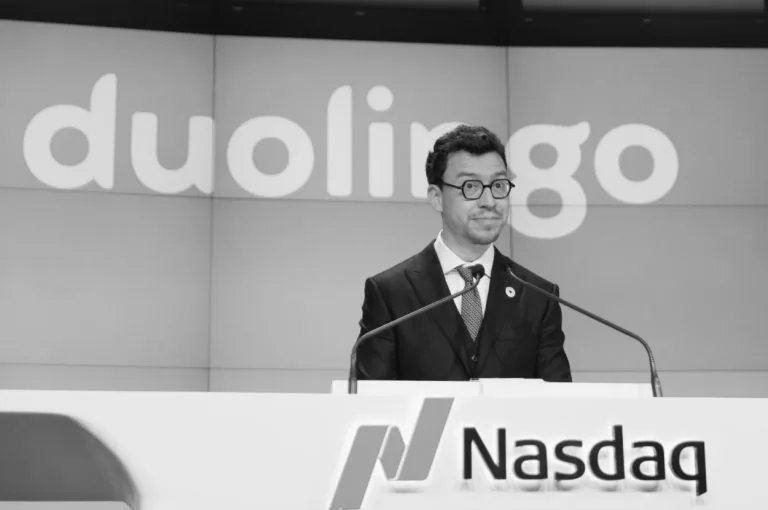
Duolingo is a language-learning platform founded in 2011 by Luis von Ahn and Severin Hacker at Carnegie Mellon University. It is the most downloaded education app in the world and the symbol of the smartphone era of language learning: in the third quarter of 2025 the company reported 135.3 million monthly active users and more than 50 million people opening the app every day. In the lineage of computer-assisted language learning, PLATO (1960) contributed interactivity and SuperMemo (1987) contributed a memory model; Duolingo contributed mass scale — a free, gamified app that turned language study into a daily mobile habit for a population larger than most countries.
From reCAPTCHA to “free language education”: the origins
Luis von Ahn arrived at language learning from an unusual direction. A Guatemalan-born computer scientist and professor at Carnegie Mellon, he had built his career on harvesting useful side effects of human effort: his reCAPTCHA system made millions of people digitize old books, a few distorted words at a time, while proving they were not robots — and was sold to Google in 2009. A MacArthur Fellow, von Ahn has often said that growing up in Guatemala he watched English proficiency function as a luxury good, priced out of reach of the people who needed it most. Duolingo’s founding mission — “free language education for the world” — was a direct answer to that, and the project began in 2009 as a PhD topic of his student Severin Hacker, who became co-founder and CTO.
The original design carried von Ahn’s signature idea. Duolingo was conceived not just as a language app but as a crowdsourced translation engine: learners would practice on real sentences from the web, their answers would be aggregated, and when many independent users converged on the same translation it would be accepted and sold — media companies such as CNN and BuzzFeed paid for translations of their articles. The learner was simultaneously the beneficiary and the workforce, which is what allowed the app to promise it would be free. Duolingo entered private beta on 30 November 2011, launched publicly on 19 June 2012, and was named Apple’s iPhone App of the Year in 2013.
The translation business, however, did not survive contact with reality: revenue from crowdsourced translation could not keep up with the costs of a rapidly growing free app, and the learner-translation feature (Immersion) was retired in January 2017. Duolingo pivoted to the model it runs today — advertising plus an optional subscription (Duolingo Plus, launched 2017, later Super Duolingo) — alongside the Duolingo English Test, a low-cost online certification exam.
The gamification model
Duolingo’s central design bet was that the biggest problem in self-directed learning is not pedagogy but dropout — most people who start learning a language alone simply stop. The company therefore engineered the app, mechanic by mechanic, around retention: the daily streak, experience points, competitive weekly leagues (introduced in 2019), hearts, virtual currency, badges, and the owl mascot Duo with its famously insistent notifications. The streak is the best-known of these — a textbook application of loss aversion, in which the pain of losing a 400-day chain outweighs the effort of a two-minute lesson.
The product is run like an experiment platform: hundreds of A/B tests per year decide what stays. The course structure itself has been redesigned repeatedly — from the original skill tree, to “crown levels” in 2018, to a single linear path in 2022; that last change provoked loud protest from long-time users, but the company kept it, citing improved retention. Lessons are deliberately short and dominated by recognition-based exercise types: matching, multiple choice, and translating short sentences with immediate feedback.
What research says about its effectiveness
The earliest efficacy evidence was commissioned by the company itself: Vesselinov and Grego (2012) found that beginners needed on average 34 hours of Duolingo to cover material equivalent to one university semester of Spanish — a striking result, though the study had high attrition and measured a self-selected group that persisted. A later study by Duolingo’s own researchers with external co-authors (Jiang et al. 2021, Foreign Language Annals) reported that learners who completed the beginner French and Spanish courses matched fourth-semester university students on reading and listening tests; speaking was not part of the comparison.
Independent research paints a consistent, more nuanced picture. Loewen and colleagues (2019, ReCALL) followed nine adults learning Turkish on Duolingo for a semester: participants did make measurable gains, and the gains correlated moderately with time spent in the app — but they criticized the scarcity of speaking practice and grammar explanation, and their motivation declined as the semester wore on. On the engagement mechanics themselves, Mogavi and colleagues (2022, ACM Learning@Scale) documented what they call gamification misuse among Duolingo users: keeping streaks alive with trivial or already-mastered lessons, farming experience points to climb leagues, and anxiety over losing streaks — cases where the motivational layer displaces the learning it was built to serve.
Summed up fairly: the evidence supports real gains in receptive skills (reading, listening) at beginner level, roughly proportional to the time genuinely spent learning. The productive side — speaking, freely constructing sentences — is where both the research and user reports consistently locate the app’s limits.
Impact on the industry
Duolingo’s first-order effect was demographic: a price of zero on a device everyone already owned created the largest cohort of language learners in history, including millions in countries where paid courses were never a realistic option. Whatever one concludes about method, the access half of von Ahn’s mission largely happened.
Its second effect was on product design. Freemium plus streaks, points and leagues became the default template of the entire category — virtually every major competitor adopted some version of the model, and “gamification-first” is now shorthand for a whole generation of learning apps. Duolingo also proved the business case: it went public on Nasdaq on 28 July 2021 (ticker DUOL) at $102 per share — an implied valuation of about $3.7 billion, closing its first day near $5 billion — and ended 2025 with over 12 million paying subscribers. The Duolingo English Test, accepted by thousands of universities since the pandemic, put price pressure on incumbent certification exams. The company’s latest chapter is contested in real time: in April 2025 it launched 148 new courses built largely with generative AI and declared itself “AI-first”, drawing significant public backlash over content quality — an open debate at the time of writing.
What this means for language learning
Duolingo settled one of the two hard problems of self-study: getting people to show up. A free app with a well-tuned habit loop demonstrably beats a textbook nobody opens, and the daily-streak ritual it popularized is genuine pedagogical infrastructure — consistency is the raw material of language acquisition. What its history equally demonstrates is that showing up is not the same as speaking: the research record shows gains tracking time-on-task and concentrating in receptive skills, with production lagging. That gap is not a scandal but a design consequence — recognition exercises are easy to gamify at scale, free sentence production is not. The broader lesson for a learner is to keep the habit and mind what fills it: the memory model that SuperMemo introduced decides when you practice, and a method built around producing whole sentences decides what the practice actually trains — Taalhammer’s approach combines both, on the interactive foundations PLATO laid in 1960.
Frequently asked questions
Does Duolingo actually teach you a language?
Research shows real but bounded results: beginner learners make measurable gains in reading and listening, roughly proportional to time spent — one company-affiliated study found course completers matching fourth-semester university students on those skills. Independent research (Loewen et al. 2019) confirms gains but points to little speaking practice and declining motivation over time. For conversational ability, the evidence suggests the app works best as one component alongside deliberate speaking and sentence production.
Why did Duolingo abandon its crowdsourced translation model?
The original plan — learners translating real web content, with the aggregated translations sold to companies like CNN and BuzzFeed — was how Duolingo intended to stay free without ads. The economics never worked at scale: translation revenue could not fund the growing product, and the Immersion feature was retired in January 2017. Duolingo switched to advertising plus an optional subscription, which remains its model today.
How big is Duolingo today?
As of the third quarter of 2025, Duolingo reported 135.3 million monthly active users, more than 50 million daily active users, and over 12 million paying subscribers by year-end. It has been the most downloaded education app in the world for years, and has been a public company (Nasdaq: DUOL) since July 2021.
Sources:
- Duolingo — Wikipedia: https://en.wikipedia.org/wiki/Duolingo
- Luis von Ahn, “Massive-scale online collaboration”, TED, 2011: https://www.ted.com/talks/luis_von_ahn_massive_scale_online_collaboration
- Roumen Vesselinov & John Grego, Duolingo Effectiveness Study, 2012: https://static.duolingo.com/s3/DuolingoReport_Final.pdf
- Shawn Loewen et al., “Mobile-assisted language learning: A Duolingo case study”, ReCALL 31(3), 2019: https://doi.org/10.1017/S0958344019000065
- Xiangying Jiang et al., “Evaluating the reading and listening outcomes of beginning-level Duolingo courses”, Foreign Language Annals 54(4), 2021: https://onlinelibrary.wiley.com/doi/10.1111/flan.12600
- Reza Hadi Mogavi et al., “When Gamification Spoils Your Learning: A Qualitative Case Study of Gamification Misuse in a Language-Learning App”, ACM Learning@Scale, 2022: https://dl.acm.org/doi/10.1145/3491140.3528274
- “Duolingo closes up 36% in Nasdaq debut, valuing company at nearly $5 billion”, CNBC, 2021: https://www.cnbc.com/2021/07/28/language-learning-app-duolingo-pops-35percent-in-public-debut-on-the-nasdaq.html
- “Duolingo Surpasses 50 Million Daily Active Users…” — Q3 2025 press release, investors.duolingo.com: https://investors.duolingo.com/news-releases/news-release-details/duolingo-surpasses-50-million-daily-active-users-grows-dau-36