Comprehensive input: Stephen Krashen, learning and acquisition (1982)
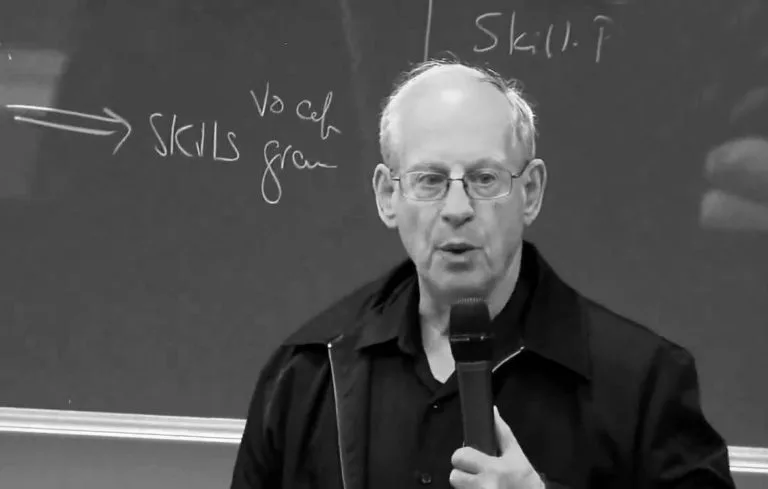
Stephen Krashen is an American linguist best known for his work in the field of second language acquisition.
In 1982 he published a very influential essay on “Principles and Practice in Second Language Acquisition”. Krashen hypothesizes that second language acquisition is very similar to the process children use when acquiring their first language. It requires meaningful interaction in the new language in which speakers are concerned with the messages and understanding, and not with the grammatical form of the language.
Krashen’s full framework, known as the Monitor Model, consists of five hypotheses. The most famous of them — the input hypothesis, with its i+1 formula — has its own entry: what is comprehensible input in language learning, where we also cover the scientific debate around the model as a whole. This entry looks in depth at the other four hypotheses: acquisition versus learning, the monitor, the natural order and the affective filter — each with its claim, its evidence and its critics.
The acquisition–learning hypothesis: two separate systems
The foundation of the whole model is the claim that adults have two independent ways of developing competence in a second language. Acquisition is a subconscious process, identical in all important respects to the way children pick up their first language: you understand messages, and grammar and vocabulary settle in by themselves, without your awareness. Acquired knowledge shows up as a feel for the language — a sentence “sounds right” or “sounds wrong”, even if you cannot say why. Learning, by contrast, is a conscious process: studying rules, memorizing paradigms, being corrected. Learned knowledge shows up as knowing about the language — being able to state the third conditional, for instance.
Krashen’s radical move was the no-interface claim: in his view, learning never turns into acquisition. Studying rules can polish your output (see the monitor hypothesis below), but only acquisition builds the system that actually produces fluent speech. Everyone knows both characters in this story: the immigrant who speaks fluently after years abroad but cannot explain a single rule, and the diligent student who can recite every rule of grammar yet freezes when ordering a coffee.
The criticism targeted precisely this wall between the two systems. Kevin Gregg (1984) and Barry McLaughlin (1987) pointed out that the distinction cannot be tested: no experiment can tell whether a given sentence was produced by “acquired” or “learned” knowledge, so the claim that only acquisition matters is unfalsifiable. Later research on skill acquisition (notably Robert DeKeyser’s work) showed that explicitly learned knowledge can become fast and automatic through practice. Today researchers keep Krashen’s distinction under the names implicit and explicit knowledge, but treat the boundary between them as permeable rather than absolute.
The monitor hypothesis: the internal editor
If learned knowledge does not produce speech, what is it for? Krashen’s answer: it works only as a monitor — an internal editor that inspects and corrects the output of the acquired system, before or after you speak. And the monitor can operate only when three conditions are met at once: you have enough time, you are focused on form rather than meaning, and you actually know the rule. In real conversation those conditions are rarely met — which is why, in Krashen’s view, grammar study contributes so little to fluency.
Krashen described three user profiles. Monitor over-users check every sentence before releasing it: they have the sentence on the tip of their tongue, start analyzing it, and often end up saying nothing — accuracy wins, communication loses. Under-users rely entirely on feel and self-correct only when a mistake “sounds wrong”. Optimal users converse freely and switch the editor on when it is cheap: in writing, in prepared speech, in proofreading.
The critique mirrors the previous one: we cannot observe whether a self-correction came from a learned rule or from acquired intuition, so the hypothesis is very hard to test — a central point of Gregg’s review. Learners also demonstrably self-correct by feel, without any statable rule. What survives is the observation almost every learner recognizes: excessive self-monitoring is real, and it kills fluency.
The natural order hypothesis: grammar has its own schedule
The third hypothesis states that grammatical structures are acquired in a predictable order — and that this order is not changed by teaching. It has the strongest empirical pedigree of the five. Roger Brown (1973) documented a consistent order in which children acquire English grammatical morphemes in their first language. Heidi Dulay and Marina Burt (1973, 1974) then tested children learning English as a second language: Spanish-speaking and Chinese-speaking children showed nearly the same acquisition order — despite having completely different first languages. Bailey, Madden and Krashen (1974) found a similar order in adults.
The order itself is familiar to every teacher of English: the progressive -ing and plural -s are acquired early; articles and irregular past forms come later; the third person singular -s and the possessive ’s come last — often years after they were first taught, no matter how early a textbook introduces them. For Krashen this was evidence that acquisition follows an inner syllabus that instruction cannot reorder.
The criticism came in two waves. Methodologically, the morpheme studies measured accuracy at one point in time and inferred an acquisition sequence from it — a questionable jump, based on a handful of English morphemes. More fundamentally, Jennifer Goldschneider and Robert DeKeyser (2001) pooled data from 12 studies and 924 learners and showed that five ordinary properties of the input — perceptual salience, frequency, semantic complexity, morphophonological regularity and syntactic category — explain most of the “natural order”. The order is real, in other words, but it may need no innate schedule: frequent, easy-to-hear forms are simply acquired before rare, unstressed ones — and third person -s is both rare and barely audible.
The affective filter hypothesis: emotions guard the gate
The term “affective filter” was proposed by Dulay and Burt (1977); Krashen made it the fifth pillar of his model. The claim: emotional variables — motivation, self-confidence and anxiety — act as an adjustable filter between the input you hear and the part of the mind that acquires language. When the filter is low, understood input “gets in” and acquisition proceeds. When it is high — you are anxious, defensive, afraid of ridicule — you may understand every word and still acquire nothing. Krashen used the filter to explain why unsuccessful learners fail despite plenty of exposure: it is not that successful learners have a special talent; it is that something is blocking the others.
The general phenomenon is among the best documented in the field. Elaine Horwitz, Michael Horwitz and Joann Cope (1986) defined foreign language classroom anxiety as a distinct construct and built the FLCAS scale to measure it; decades of studies since have confirmed a consistent negative correlation between language anxiety and achievement.
The criticism concerns the mechanism, not the phenomenon. Gregg asked the questions the hypothesis cannot answer: how exactly does an emotion selectively block input from reaching the “language acquisition device”, and why would the filter rise at puberty in all humans? A correlation between anxiety and results does not prove a filter on input — anxiety may equally harm retrieval, willingness to speak, or the amount of practice a learner seeks out. The practical reading, though, is uncontroversial: an environment where you feel safe to make mistakes measurably helps.
The fifth hypothesis: comprehensible input, in brief
The input hypothesis ties the model together: acquisition happens when you understand messages containing language slightly above your current level — Krashen’s famous i+1. Together with the four hypotheses above it formed the basis of the Natural Approach (Krashen and Terrell, 1983), which expected language to emerge on its own once learners had understood enough of it. We cover the input hypothesis in depth — the formula, the examples, and the criticism from Swain, Gregg and McLaughlin — in the companion entry on comprehensible input in language learning.
What this means for language learning
- Build on understanding, but do not throw away the grammar book. Krashen was right that massive comprehensible input is the foundation; the research since shows that explicit learning, practised enough, feeds fluency too. The two systems cooperate more than the model allowed.
- Use your monitor as an editor, not a gatekeeper. Communicate first, correct afterwards. If you catch yourself analyzing a sentence instead of saying it, that is the over-used monitor at work — say it with the mistake.
- Expect some structures to resist. If third person -s or articles will not stick, that is the natural order, not your failure. Keep meeting the form in sentences you understand instead of re-reading the rule.
- Lower the filter deliberately. Familiar topics, a safe place to make mistakes, and early small wins reduce anxiety — the variable with the best-documented effect on results. This combination of input, sentence practice and low-pressure repetition is the core of the Taalhammer method.
Frequently asked questions
What are the five hypotheses of Krashen’s Monitor Model?
The acquisition–learning hypothesis (two independent ways of developing language), the monitor hypothesis (learned rules only edit output), the natural order hypothesis (grammar is acquired in a fixed sequence), the input hypothesis (acquisition comes from understanding messages at level i+1) and the affective filter hypothesis (anxiety and low motivation block input from being acquired).
What is the difference between language acquisition and language learning?
In Krashen’s terms, acquisition is subconscious — you pick the language up by understanding it, the way children do, and the result is a feel for what sounds right. Learning is conscious study of rules, and the result is knowledge about the language. Krashen claimed only acquisition produces fluent speech; modern research treats the two as connected, since practised explicit knowledge can become automatic.
Is Krashen’s Monitor Model still accepted today?
As a package, no — its central claims proved hard to test, and the strict separation of learning from acquisition has been abandoned. But its core insights survived: comprehensible input is regarded as necessary for acquisition, the natural order is a robust finding (now explained by properties of the input), and the effect of anxiety on learning is one of the best-replicated results in the field.
Sources
- Krashen, S. D. (1982). Principles and Practice in Second Language Acquisition. Oxford: Pergamon Press.
- Dulay, H. C., & Burt, M. K. (1974). Natural sequences in child second language acquisition. Language Learning, 24(1), 37–53.
- Gregg, K. R. (1984). Krashen’s Monitor and Occam’s Razor. Applied Linguistics, 5(2), 79–100.
- Horwitz, E. K., Horwitz, M. B., & Cope, J. (1986). Foreign language classroom anxiety. The Modern Language Journal, 70(2), 125–132.
- Goldschneider, J. M., & DeKeyser, R. M. (2001). Explaining the “natural order of L2 morpheme acquisition” in English: A meta-analysis of multiple determinants. Language Learning, 51(1), 1–50.
- McLaughlin, B. (1987). Theories of Second-Language Learning. London: Edward Arnold.