Chinese: A Journey Through Language
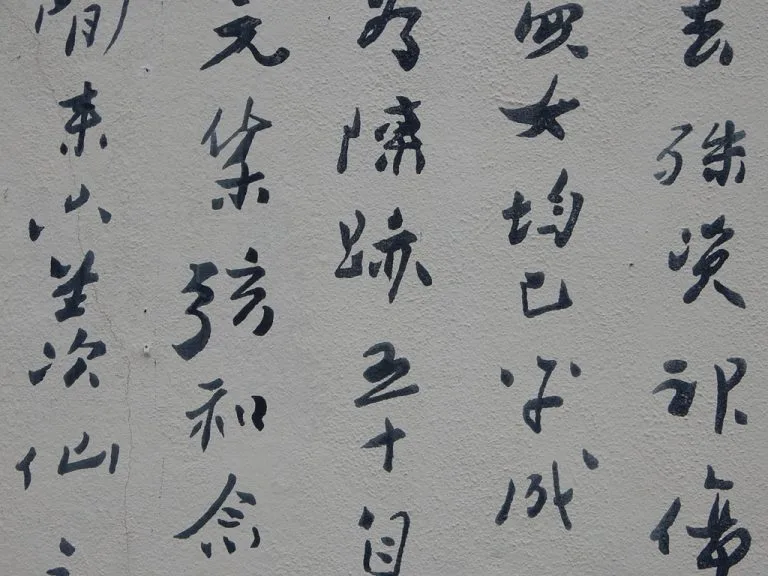
“Chinese” is not a single language but a whole family of them — the Sinitic branch of the Sino-Tibetan family. What English calls Chinese (in Chinese, Hanyu, 汉语, “the Han language”) covers a group of related varieties that are often as different from one another as the Romance languages of Europe, yet are traditionally grouped together because they share one writing system and one literary tradition. Taken as a whole, Chinese has more native speakers than any other language on Earth — well over a billion. The variety almost everyone means when they say they are “learning Chinese” is Mandarin, the basis of the modern standard language.
A family, not a single language
Linguists usually count seven to ten major groups of Sinitic varieties. The largest by far is Mandarin (北方话, the “northern speech”), spoken across northern, central and western China and native to roughly 70% of all Chinese speakers. The others include Wu (including Shanghainese), Yue (whose best-known member is Cantonese, spoken in Guangdong, Hong Kong and Macau), Min (including Hokkien and Taiwanese), Hakka, Xiang, Gan and Jin. Speakers of different groups generally cannot understand one another in speech: a Mandarin speaker and a Cantonese speaker are about as mutually unintelligible as an Italian and a Spaniard. Calling these “dialects” rather than “languages” is a political and cultural convention, not a linguistic one — the shared script and the idea of a single Chinese nation hold them under one name.
The standard spoken language is based on the Beijing dialect of Mandarin. It goes by several names depending on where it is spoken: Putonghua (普通话, “common speech”) in mainland China, Guoyu (国语, “national language”) in Taiwan, and Huayu (华语) in Singapore and Malaysia. This is the variety taught to foreigners, used in schools and broadcasting, and meant by “Standard Chinese” throughout the rest of this article.
The writing system: characters, not an alphabet
Chinese is written with characters (汉字, hanzi) rather than an alphabet. The system is logographic, or more precisely morphosyllabic: each character stands for one syllable and, in most cases, one unit of meaning (a morpheme). There is no small set of letters that spell out sounds — instead there are thousands of distinct characters that must be learned individually. This is the single feature that most sets Chinese apart from the languages an English speaker already knows, and the reason a beginner cannot simply “sound out” a word from the page.
Characters are not random pictures. Most are phono-semantic compounds: they combine a radical (a component hinting at meaning) with another component hinting at pronunciation. There are 214 traditional radicals, and learning to see these building blocks turns a wall of strokes into an analysable system. Still, the numbers are large. Comprehensive dictionaries list well over 50,000 characters; functional literacy — reading a newspaper — needs roughly 3,000 to 4,000; an educated adult knows perhaps 8,000. Words in modern Chinese are frequently built from two characters (电 diàn “electric” + 脑 nǎo “brain” = 电脑 diànnǎo “computer”), so vocabulary grows faster than the raw character count suggests.
Since the 1950s and 1960s the People’s Republic of China has used simplified characters (简体字), in which many common characters were given fewer strokes — 馬 became 马 (mǎ, “horse”), 語 became 语 (yǔ, “language”). Simplified characters are standard in mainland China, Singapore and Malaysia. Traditional characters (繁體字), the older unsimplified forms, remain standard in Taiwan, Hong Kong and Macau. The two systems overlap heavily and a reader of one can usually manage the other with some effort, but a learner should decide early which to focus on. Crucially, the written character is the same regardless of how it is pronounced: a Mandarin and a Cantonese speaker read 我 as “I / me” even though they say it completely differently — which is why the script has historically unified a country of mutually unintelligible speech.
Tones and pinyin
Standard Chinese is a tonal language: the pitch contour of a syllable is part of its meaning, not just its emotion or emphasis. Mandarin has four tones plus a neutral tone. The classic illustration uses the syllable ma:
- First tone — high and level (mā, 妈, “mother”);
- Second tone — rising, like a question (má, 麻, “hemp”);
- Third tone — dipping down then up (mǎ, 马, “horse”);
- Fourth tone — sharp and falling (mà, 骂, “to scold”);
- Neutral tone — short and unstressed, with no contour of its own (the ma in 吗, a question particle).
Getting the tone wrong changes the word, not merely the accent — so tones must be learned as an integral part of each syllable from the very beginning. Other varieties have their own systems: Cantonese is usually analysed as having six tones, more than Mandarin. Tones also interact: Mandarin has tone sandhi rules, the best-known being that two third tones in a row shift the first to a rising tone.
Because characters give no reliable clue to pronunciation, Chinese is taught with pinyin (拼音, “spelled sound”), the official romanization introduced in mainland China in 1958. Pinyin writes Mandarin syllables in the Latin alphabet with tone marks (nǐ hǎo, 你好, “hello”), and it is how most learners first meet the language and how Chinese is typed on phones and keyboards. It is a learning aid and an input method, not a replacement for characters. Older Western texts used the Wade–Giles system (hence spellings like “Peking” and “Tao”), and Taiwan often teaches pronunciation with Zhuyin (Bopomofo), a separate phonetic script.
Grammar: isolating and uninflected
Grammatically, Chinese is the opposite of a language like Latin or Russian. It is an isolating (analytic) language: words do not change their form. Verbs are not conjugated for tense or person, nouns have no plural or case endings, there is no grammatical gender, and there are no articles (“a”/“the”). The word 学 (xué, “learn/study”) is the same whether the subject is I, you or they, and whether the action is past, present or future.
Meaning is carried instead by word order and by small function words. The basic order is subject–verb–object, much like English, and Chinese is strongly topic-prominent (a sentence often begins by naming what it is about). Time is expressed with time words (“yesterday”, “tomorrow”) and with aspect particles rather than tenses: 了 (le) marks a completed or changed situation, 着 (zhe) an ongoing state, 过 (guo) a past experience. This makes Chinese morphology genuinely simple — there is far less to memorise than in an inflected European language.
The famous complication is classifiers (measure words). You cannot say “three books” directly; a classifier must sit between the number and the noun — 三本书 (sān běn shū), literally “three [volume-classifier] book”. Different nouns take different classifiers according to shape or category — 个 (gè) is the general default, 本 (běn) for bound volumes, 只 (zhī) for many animals, 张 (zhāng) for flat things. English does this only occasionally (“two sheets of paper”, “a head of cattle”); Chinese requires it everywhere, and choosing the right classifier is a steady, low-grade demand on the learner.
Learning Chinese: how hard, and how it is measured
For an English speaker, Mandarin sits in the hardest bracket. The U.S. Foreign Service Institute classifies it as a Category IV “super-hard” language — the same tier as Arabic, Japanese and Korean — estimating around 2,200 classroom hours (about 88 weeks of full-time study) to reach professional working proficiency, roughly three to four times what an easy language like Spanish or Dutch takes.
The difficulty is unevenly distributed, and it helps to know where it sits. The hard parts are the writing system (thousands of characters with no sound-to-spelling shortcut), the tones (an entirely new dimension of pronunciation that also strains listening), and the fact that the vocabulary shares almost nothing with English — there are very few cognates to lean on. The easier parts genuinely exist: the grammar has no conjugation, declension, gender or agreement, so once you have the words and the tones, sentence-building is comparatively forgiving.
Progress is usually measured with the HSK (Hanyu Shuiping Kaoshi, 汉语水平考试), the official standardised test of Mandarin for non-native speakers. The long-standing version had six levels; the revised HSK 3.0, announced in 2021 and rolling out fully in 2026, expands this to nine levels grouped into three bands — foundational (1–3), intermediate (4–6) and advanced (7–9) — with the top band requiring around 3,000 characters and some 11,000 words. The HSK gives learners a concrete ladder, and its levels map loosely onto the CEFR framework used for European languages. (Cantonese and the other varieties have far less in the way of standardised testing, another sign of Mandarin’s special status.)
What this means for learning a language
The structure of Chinese turns some general principles of language learning into hard requirements.
First, the 2,200-hour FSI estimate is a distance, not a verdict. It measures a high bar — professional proficiency — and assumes an intensive classroom pace; a more modest conversational goal is a much shorter project. What the number really says is that Chinese is cumulative work with no shortcut, so the honest question is not “how do I avoid the hours?” but “how many minutes a day can I keep up?” The realities behind that figure are worth understanding before you start — see how long it takes to learn a language according to the FSI.
Second, because characters do not encode sound and because tones carry meaning, pronunciation and listening cannot be postponed. Pinyin is a scaffold, not the language; a learner who leans on it without training the ear ends up unable to understand real speech. Getting the sounds and tones right from the start is easier when you can think about pronunciation precisely, which is what a system like the International Phonetic Alphabet is for.
Third, and most practically, thousands of characters and word–tone pairings have to be moved into long-term memory, and there is no rule that will generate them for you — each is a convention that must be stored and repeatedly recalled. That is exactly the problem that methods built on active recall and spaced repetition are designed to solve, and it is why learning characters and words inside whole sentences — where tone, meaning and classifier appear together — beats memorising them in isolation.
FAQ
Is Chinese one language or many?
Linguistically it is a family of related but mutually unintelligible languages — Mandarin, Wu, Cantonese (Yue), Min, Hakka and others — traditionally called “dialects” because they share one writing system and one literary culture. In everyday use, “Chinese” usually means Standard Mandarin (Putonghua), the official spoken language and the one taught to learners.
Do I have to learn thousands of characters?
To read and write, yes — Chinese has no alphabet, so literacy means learning characters individually. But the practical target is smaller than the dictionary suggests: around 3,000 characters cover the great majority of everyday text. Learners typically start with pinyin (the Latin-alphabet romanization) to master pronunciation and speech, then build character knowledge steadily on top of it.
How hard is Mandarin for an English speaker?
It is one of the hardest. The Foreign Service Institute rates Mandarin as a Category IV “super-hard” language, needing roughly 2,200 hours for professional proficiency — about three to four times an easy language. The grammar is actually simple (no conjugation or plurals), but the writing system, the tones and the near-total lack of shared vocabulary make several things new at once.
Sources
- “Chinese languages”, Encyclopaedia Britannica.
- “Varieties of Chinese”, Wikipedia (Sinitic groups, mutual intelligibility, speaker numbers).
- “Chinese characters”, Wikipedia (hanzi, radicals, simplified vs traditional).
- “Standard Chinese phonology”, Wikipedia (the four tones, neutral tone, tone sandhi) and “Pinyin”.
- U.S. Department of State, Foreign Service Institute — Foreign Language Training (Category IV, ~2,200 hours), and “Hanyu Shuiping Kaoshi (HSK)”, Wikipedia (levels).