Benny Lewis and the polyglot community: Language learning is global (2013)
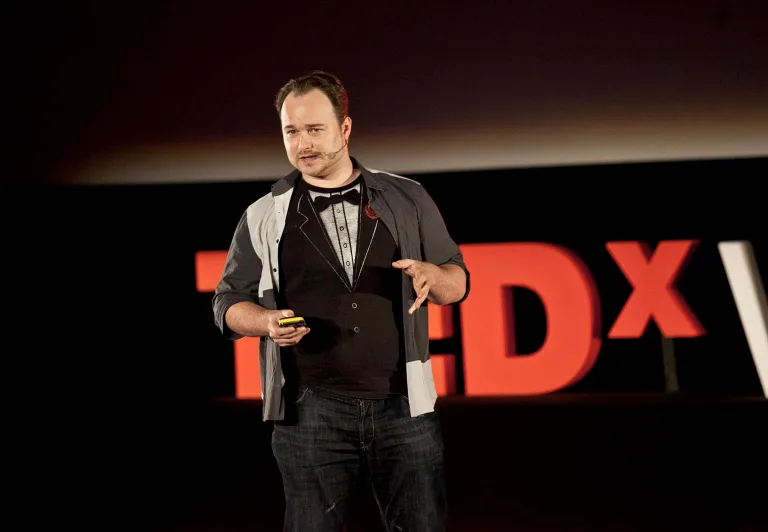
Benny Lewis (born 1982) is an Irish blogger, author and self-described "language hacker" who, more than any academic, popularised the idea that ordinary adults can learn to speak foreign languages — and that the first thing to do is open your mouth. Through his blog Fluent in 3 Months, launched in 2009, his 2014 book of the same name, and a string of TEDx talks and YouTube videos, Lewis became the best-known face of a loose, global movement of hobbyist polyglots. He is not a linguist or a researcher, and his most famous slogan is more marketing than science; his genuine importance lies elsewhere — in helping millions of people believe that language learning is not a talent you are born with but a habit anyone can build, and in giving that belief a worldwide community to belong to.
The story of Lewis is therefore inseparable from the story of the online polyglot scene that grew up around him in the same years: the Polyglot Conference, the Polyglot Gathering, and figures such as Richard Simcott, Luca Lampariello and Steve Kaufmann. Together they turned what used to be a solitary, faintly eccentric pursuit into something social, visible and — crucially — imitable.
Benny Lewis and "speak from day one"
Lewis is the opposite of a child prodigy. He has said openly that he was mediocre at languages in school — a poor grade in German, barely passing Irish — and graduated from University College Dublin with a degree in electronic engineering, not languages. After moving to Spain he spent the better part of a year failing to learn Spanish by the usual means: classes, grammar books, and waiting until he felt "ready" to speak. The turnaround, by his own account, came when he abandoned that patience and simply started talking — badly, constantly, and without embarrassment.
That experience hardened into his central message: speak from day one. Instead of studying a language for months before daring to use it, the learner should use it immediately, tolerating a torrent of mistakes as the price of progress. Early sentences might be crude — "me want go supermarket" — but they generate the one thing textbooks cannot: real conversations, real feedback, and the emotional habituation that turns speaking from a terror into a routine. Lewis packaged this into practical tactics: conversation exchanges from the first week, deliberate use of mnemonics and cognates to bootstrap vocabulary, "language hacks" that lower the barrier to a first exchange, and above all a mindset that treats mistakes as data rather than failure. He later distilled the approach into a method he branded Language Hacking.
His own biography became the argument. Lewis undertook public "missions" — three-month attempts to reach a speaking level in a new language, documented online — accumulating experience in more than twenty languages to widely varying degrees. Whatever one thinks of the results, the demonstration mattered: here was an ordinary, self-confessedly untalented adult using a language in public within weeks, which is precisely the thing most learners believe they cannot do.
The polyglot community: from solitary hobby to global movement
Before the web, serious language hobbyists tended to be isolated — a person quietly studying six languages in a provincial town, with no one to practise or compare notes with. The internet dissolved that isolation, and around 2010 the scattered individuals began to find each other. The pivotal moment was in-person: in 2013, Richard Simcott and Luca Lampariello organised the first Polyglot Conference in Budapest. Simcott, a British polyglot who has studied dozens of languages, and Lampariello, an Italian known for speaking around a dozen at a genuinely high level, had met through the community and wanted to bring its members into one room. By its tenth-anniversary edition in 2023 the event drew well over a thousand participants, and the broader online polyglot community is often estimated in the hundreds of thousands.
A parallel event, the Polyglot Gathering, was founded in Berlin in 2014 by German polyglot Judith Meyer together with Chuck Smith and Martin Sawitzki, explicitly inspired by the Budapest conference; it grew from 231 participants in its first year to several hundred within two. Alongside the live events, a YouTube-centred culture flourished: Steve Kaufmann, a Canadian former diplomat, co-founder of the LingQ learning platform and an advocate of learning through massive reading and listening, became one of its most watched voices, as did Lampariello, Simcott's "Speaking Fluently", and David Mansaray. What united these people was not a shared method — they disagreed sharply about how to learn — but a shared temperament: most had no special gift, only a love of languages, a need to communicate, and the persistence to take learning into their own hands.
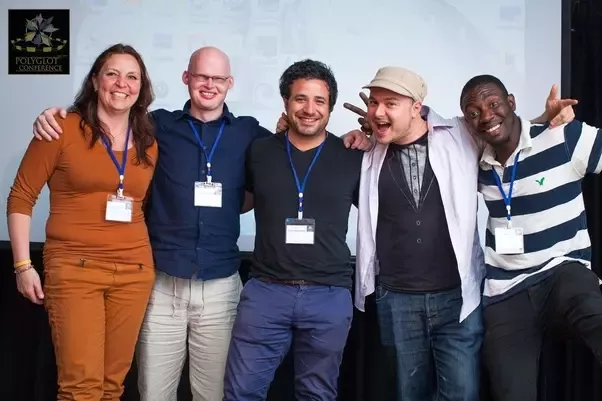
The significance of the community is easy to underrate. It normalised the idea that adults can and do learn languages for pleasure; it produced an enormous amount of free, practical, learner-facing advice; and it created role models for people who had been told, usually at school, that they simply were not "language people".
Speaking from day one versus input first: an honest look at both
The polyglot scene is often presented as united, but it contains a real and interesting disagreement about how languages are best learned — one that maps onto a genuine debate in linguistics. Lewis sits firmly on the output-first side: use the language, speak early, learn by doing and by making mistakes. On the other side stand the input-first advocates, whose intellectual anchor is the linguist Stephen Krashen. Krashen's influential (and much-debated) theory holds that we acquire language mainly by understanding messages — comprehensible input slightly above our current level — and that a "silent period" of listening and reading before speaking is natural and even beneficial. Steve Kaufmann is the community's most prominent embodiment of this view: read and listen for hundreds of hours, and speaking will largely take care of itself.
It would be dishonest to declare a winner, because the research does not. Comprehensible input is very widely accepted as necessary — you cannot acquire a language you never encounter — but Krashen's stronger claims (that conscious study and output barely matter) are contested and not well supported. On the other side, Merrill Swain's output hypothesis (1985) argues that producing language does distinctive work that input alone does not: speaking and writing force you to notice gaps in what you know, test hypotheses about how the language works, and process it more deeply than passive comprehension requires. In practice the two camps are less opposed than their slogans suggest. Serious input-based learners eventually speak a great deal; serious "speak from day one" learners consume enormous amounts of input to have anything to say. The honest summary is that both abundant understandable input and real, used-in-anger output matter, and the fights are mostly about sequencing and emphasis — when to start speaking, and how much to worry about errors — not about whether each is needed.
Criticism and influence: what "3 months" really means
The obvious target for criticism is the brand itself. "Fluent in 3 Months" is a superb piece of marketing and a poor scientific claim, and it has drawn steady criticism — from other polyglots, Steve Kaufmann among them, and from learners who point out that reaching genuine fluency in a hard language in twelve weeks is, for almost everyone, not realistic. The counts are stubborn: institutions like the US Foreign Service Institute reckon even an "easy" language takes hundreds of class hours plus independent study to reach solid professional proficiency, and harder languages far more.
Two things make the criticism fairer when qualified. First, Lewis defines "fluency" narrowly and idiosyncratically: he means social equivalency — being able to function in ordinary social situations roughly as you would in your native language — which is closer to a confident conversational B1–B2 than to near-native mastery. Second, he has repeatedly clarified that the title is not a universal promise: it describes his pattern of moving to a country for about three months and aiming to speak the local language, with intensive daily effort, not a guarantee for someone studying an hour a week. The reasonable verdict is that the headline oversells and the fine print corrects it — and that the number does real motivational work, pulling hesitant beginners past the fear of starting, even as it risks setting expectations that quietly disappoint.
Set against that, Lewis's influence on the culture of language learning is large and mostly positive. He helped shift the popular conversation away from "do you have a gift for languages?" toward "are you willing to practise and be wrong in public?" — a far more useful question. He gave a generation of self-directed learners permission to speak imperfectly, a vocabulary ("language hacking", "missions", speaking from day one) to organise their effort, and, through the community he was part of, the sense that they were not alone. The downside is the flip side of the same coin: an influencer economy in which hype about speed and effortless polyglottery can drown out the unglamorous truth that languages are learned through sustained, repeated work.
What this means for language learning
Strip away the marketing and the polyglot movement leaves behind advice that holds up well:
- Start using the language early — and don't fear mistakes. Lewis is right that most learners wait far too long to speak. Errors are how you find out what you don't yet know; treating them as data rather than failure removes the single biggest psychological brake on progress.
- But feed the machine with input. The input-first camp is right that you can only say what you have first understood. The two are partners, not rivals: consume a lot of understandable material and use it. This is also why comprehensible input and active production both belong in a serious routine.
- Talent is not the variable that matters. The community's clearest lesson is that its members are, mostly, not gifted — they are persistent. Which makes the real bottleneck not method but motivation and consistency: the daily habit that keeps you showing up long after the novelty fades.
- Be sceptical of speed claims — including "3 months". Fast, confident conversation is a realistic and worthy early goal; native-like fluency in weeks is not. Aim for the former, and judge tools and teachers by whether they build a durable habit rather than promise a shortcut.
The practical synthesis is unremarkable and effective: learn language you actually want to say, get it into your ears and eyes in quantity, and start producing it out loud almost immediately. That is exactly the logic behind a method built on practising full sentences — meaningful input you then reproduce and reuse, until speaking stops feeling like a leap.
Frequently asked questions
Can you really become fluent in a language in 3 months?
It depends entirely on what "fluent" means. If it means comfortable, functional conversation on everyday topics — what Benny Lewis calls "social equivalency", roughly a B1–B2 level — then with intensive daily practice and immersion it is achievable for many people in an easier language. If it means near-native mastery across reading, writing, listening and speaking, then no: for almost everyone that takes years, and institutions like the Foreign Service Institute measure it in many hundreds of hours. The "3 months" figure is best read as motivation to start now, not a literal guarantee.
Should I speak from day one, or listen and read first?
Both approaches work, and the honest answer is that you need both input and output. "Speak from day one" (Lewis) lowers the fear barrier and generates real feedback fast; "input first" (Krashen, Kaufmann) ensures you have understood a lot of language before you try to produce it. The evidence supports abundant comprehensible input as necessary, and Swain's output research shows that speaking does distinctive work input alone can't. In practice, get plenty of understandable material into your head and start using it early — the disagreement is about emphasis and timing, not about whether each is needed.
Who are the main figures in the online polyglot community?
Benny Lewis (Fluent in 3 Months) is the best-known populariser of speaking early. The Polyglot Conference (from 2013, Budapest) was organised by Richard Simcott and Luca Lampariello, and the Polyglot Gathering (from 2014, Berlin) by Judith Meyer and colleagues. Steve Kaufmann, co-founder of LingQ, is the leading voice for input-based learning through massive reading and listening. What unites them is not a single method — they disagree — but the conviction that adults can learn languages through persistence rather than talent.
Sources
- Lewis, B. (2014). Fluent in 3 Months: How Anyone at Any Age Can Learn to Speak Any Language from Anywhere in the World. HarperOne.
- Benny Lewis — Wikipedia (biography, blog launch 2009, TEDx talks, definition of fluency, criticism).
- Krashen, S. D. (1982). Principles and Practice in Second Language Acquisition — the input hypothesis and comprehensible input.
- Swain, M. (1985). "Communicative competence: Some roles of comprehensible input and comprehensible output in its development" — the output hypothesis.
- Polyglot Conference — Our History and Richard Simcott — Wikipedia (first conference, Budapest 2013).
- Polyglot Gathering — founding in Berlin (2014) by Judith Meyer, Chuck Smith and Martin Sawitzki; participant numbers.
- Kaufmann, S. — LingQ and public writing on input-based learning.